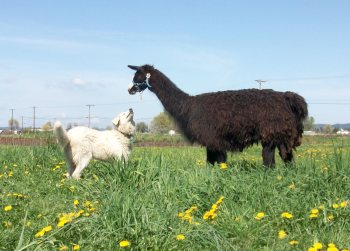
 Here is our livestock guardian pair, displaying their somewhat adversarial relationship. Neither one is really afraid of the other, and they haven’t thus far hurt each other and don’t seem to have intent to. But, the dog enjoys getting some sport out of hassling the llama by barking at her, and leaping up to air-snap at her head. This annoys the llama to no end, and she swings her long neck around with flattened ears, trying to communicate her irritation. Sometimes she even spits at the dog, but the dog doesn’t mind and keeps at her lively sport. 🙂 Continue reading “The Odd Couple: Ears, Eyes, Bark and Bite”
Author: fourfarmdogs
Living With Coyotes: Part 2
 How to live in balance with your local coyote population? Here’s some of my thinking and learning thus far.
Of course the first temptation is to shoot at them, there is a very alluring promise of an immediate sense of “justice” and relief of seeing that thief dead! Removing certain animals from the population is a valid part of predator management. But, only a part. Continue reading “Living With Coyotes: Part 2”
Living With Coyotes: Part 1

We are sure having trouble with the coyotes this year. Last year, we experienced almost zero predation, I think we had one duck go missing all year, and no sheep losses. We rarely saw coyotes during the day, and when we did, they were off in the distance, hunting mice in the fields. At a human encounter, they quickly made themselves scarce. We heard them howling at night, so knew they were present, but we were all coexisting OK.
But, starting in January, that has drastically changed! Continue reading “Living With Coyotes: Part 1”
Tiny Chicken
 Check out this tiny chicken. These are all Rhode Island Reds, and they looked identical when I got them. But this one isn’t growing like the rest of them. Continue reading “Tiny Chicken”
Historic Craftsman Porch Restoration
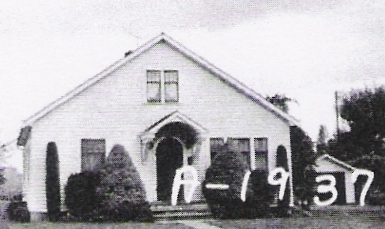
Our house has a peculiar combination of architectural styles. It was mostly a basic cottage, originally, built around 1929 (1937 tax photo above). But when it was moved to this site, I added a taller second story, which made it look more like a Farmhouse-style house. Yet tacked onto the front of it is a decidedly Craftsman porch overhang, even though there isn’t much else Craftsman about the house. Continue reading “Historic Craftsman Porch Restoration”
Attention Deficit Mouse Hunter
 This is Mrs. Pete, our cat. She does ok at contributing to the farm by killing mice, but I think only by pure luck and the fact that there are SO many mice! As you can see in this picture, her attention span is very short. She has already forgotten that she has a yet-to-be-killed mouse before her, and she’s gazing off into the distance. Mice can outwit her by running in between her hind legs and escaping, and she cannot figure out where they went. Continue reading “Attention Deficit Mouse Hunter”
We Sold a House In The Crummy Economy
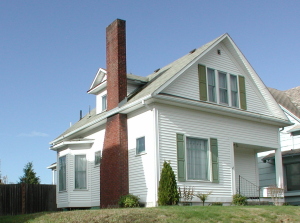 We are pretty excited, Kirk’s house sold this month. We put it on the market mid-November, thinking, “well, let’s give it a try.” We honestly expected it would not sell for at least 6-9 months, and that we’d probably end up giving up and renting it. But, we hoped not- we didn’t want it trashed by renters, and we didn’t want to be landlords. And, we knew we’d prefer to take the cash invested in it, and use it for other things, like building a barn. And, we felt that the cash invested in it would not be earning much equity in the next few years!
I am an avid reader and fan of the Seattle Bubble blog, and the data there was never encouraging! When we listed the house, the Months-of-Supply stats for Snohomish county were heading towards twelve months! That essentially means that the average house will have to sit on the market for a year before it sells. Yikes! That’s a lot of mortgage payments and taxes for an empty house!
But, we had a few things on our side that made us slightly more optimistic. For one, nobody was living in the house, so we could get it, and keep it, perfectly clean. We were able to clear out the closets and cupboards, and take away everything but some key furniture, so it was staged very nicely. And, the house is just beautiful inside. The fir floors are exquisite, and the original woodwork, trim and stained glass windows are fabulous. It is definitely an elegant and unique home, and there aren’t dozens and dozens of comparables, like with new construction.
And, we didn’t use a real estate agent. The biggest advantage here is that we didn’t need to buffer in that extra 3% in the price to pay that agent’s wages. Instead, we essentially passed that savings onto the buyer (since we’d never see the money either way) to encourage the house to sell faster, as compared to our higher-priced competitors who have to pay their agent.
And, honestly, I think that when there are two real estate agents in the mix, sometimes negotiations can actually be tougher than if you just meet, as two sets of ordinary people, face-to-face, and come to an agreement at the kitchen table. Certainly the agents aren’t there to get the best price for either party (since it doesn’t translate into much difference in their commission either way). They are just there to push everybody to finish the deal as quickly as possible so they can get their check and move on to other sales.
I also believe that me being able to spend a LOT of time on the photos, flyer and web advertising made a big difference. I doubt many agents invest as much in those key pieces of marketing than I did. And, since I’m a software engineer, my skills in using photo and flyer editing software, and creating web pages, is probably higher than the average real estate professional.
So, in the end, it worked out well. The people who bought the house were indeed able to meet us face-to-face. I think that really helps put everybody at ease, that they’re not doing a deal with the devil behind a curtain or something. They had an agent, and I think she was really working more for us than them. She revealed to us right away that they’d been searching for months, and that they were all tuckered out from the ordeal. It was clear she was anxious to be finished with this sale herself.
They met us on a Friday night, after a full work week, they appeared to have missed dinner, and they looked exhausted and a little desperate. They waited outside in the cold car in the dark, with their kids, while we talked with their agent. I have no idea why they didn’t say “hey, let’s get some sleep and negotiate Saturday morning when we’re all fresh!” since it’s not like there is huge competition out there between buyers. So, that made it pretty easy for us, it was clear they wanted the house. We agreed quickly on a price, and that there would be no repair requests after the inspection. And that was that!
The offer came four months after listing the house, for a very satisfactory and fair price, and it closed in a month’s timeframe. Nice! I held my breath until we had that check in hand! I’m excited for the house, the people who bought it love it and care about its history, so I think they’ll be good stewards to the old beauty. And we are so glad to never have to mow a town lawn again!
Herding Mayhem
 When we got Bronte the LGD, I was a bit worried about how things would go when she was first introduced to the Border Collies. While she was penned with the sheep in the small pen, if the Border Collies passed by outside the pen, she would snarl and threaten them. Which is good, it’s her job to deter strange dogs that look like they want to eat the sheep. But, clearly it would be ideal if the Border Collies could work without having to to lock up the LGD.
It turns out, there was nothing to worry about. When I first moved the sheep down to the pasture, a few times I had to work them, to get them into their Electronet pen. So, I just did it, to see how it would go. And Bronte was OK with it. The only annoying thing is she definitely gets in the mix. She is curious about the Border Collies, and wishes they would play. But, they ignore her, like she is a gnat flying around in their field of view, not a nearly 100 pound pup trying to pounce on them! They have zero interest in play or fraternizing with other dogs when there are sheep to work.
So, it makes for challenging herding. Bronte switches between getting in the way of the collies and getting in the middle of the sheep, and then sometimes throws in some llama-hassling for fun, too. It’s good practice for the collies, they really have to handle a lot of different pressure points when there is a dog running randomly through the sheep, the llama is sparring with the dog, and then the ewes are all stubborn and protective of their lambs and don’t want to move.
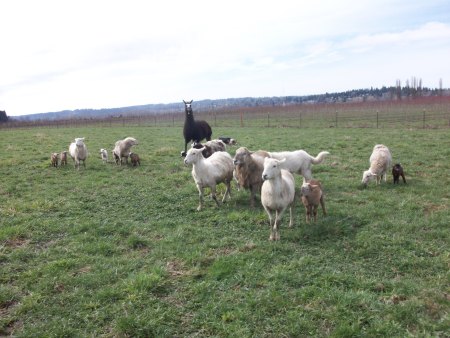
In this photo, you can see Maggie way in the back, behind the llama (who is showing her Angry Ears at this process). Maggie is trying to get this crowd bunched together and moving towards me. But Bronte is strolling through the middle, with her tail high in delight over the mayhem. The ewes are all spread out, and they turn on Maggie and stomp if she pushes too hard. But, she is able to get the job done, with some patience and an occassional, warranted grip.
I haven’t been working Gene as much, because this is very difficult for her and takes more time. Gene will feel too much pressure and kick out “into orbit,” and it’s hard for me to call her in to work the sheep consistently with all this chaos, she doesn’t like it. And, if she is off contact, the sheep spread too much, Bronte starts pulling on lamb tails and legs, and I start to yell! Hopefully a little later in the summer Gene will get some more chances to work, once Maggie has the lambs all dog broke.
Maggie is also the best tempered for the chore I am doing every three days now: moving the Electronet “square.” Maggie is “sticky” – she loves nothing more than to get sucked into the sheep, using her eye, and get them in a deadlock where nobody is moving. This is a very annoying trait when I want her to move them and she is frozen in space and time, and no amount of verbal commanding can un-stick her. But, it comes in handy when I need her to hold! I can park her anywhere holding the sheep and leave her, and she’ll keep them there.
So, when I’m ready to move the square, I park Maggie in the sheep in one corner of it. I move the other corner, then move Maggie and the sheep into it. Then I move the other half and box them all back in, and call Maggie off. I find that having Maggie hold the sheep in a tight bunch makes things less risky while Bronte has access to the sheep. She is less stimulated by that, versus having the sheep spread out in the pasture, where she can start to chase them and get to tugging on the lambs. I don’t want her to get in the habit of this, so I try to keep things very boring for her when she has a few minutes “in” with the sheep.
Shedding Sheep
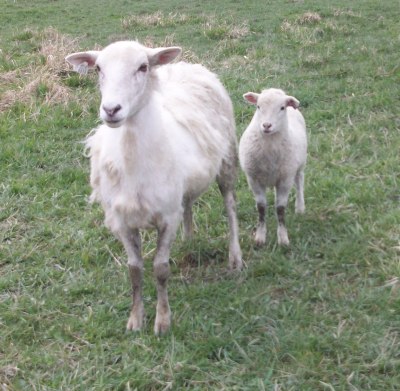 Our Katahdins are all in various states of shedding off their winter hair coats. This is #10 and her ram lamb. You can see her winter coat peeling off her shoulders. Once they are done shedding, they look so clean and trim!
The birds have been appreciating the wool in the field, we often see them carrying it off for nesting material.
A few days ago, when I was out in the field moving fencing, a woman stopped by. She asked if I would move the dog house to be closerto the sheep, so that Bronte would be more likely to use it (she hasn’t gone near it that I know of). The woman and I talked for a while, I told her a bit about the Maremma breed, and about Bronte and her life as a livestock guardian. In the end, she said, “ok, thank you, I feel better now.” I guess it’ll just take a lot of education to convince people that Bronte’s life isn’t so horrible after all!
Garden Beds
 We’ve been working on our new garden beds for the last several months. Kirk built these three raised beds using barn wood- these are floor joists from the second story. Though the boards have some damage, they are so thick, they should still last another 100 years!
We considered having topsoil brought in, but ended up using what we have here. Kirk scooped up soil outside of the barn, which was mostly made of old barn waste (manure + whatever else was in there years ago). Later I mixed in sand, which we also have in streaks throughout our property. Lastly, I added most of the layers of straw bedding from the ducks’ A-frame shelter, which had been composting since last fall.
I rototilled all this in. A lot of rocks ended up coming with the barn waste soil, as I think that manure was on top of what was originally a rock driveway; and in some places, we dug a bit too deep when scooping it up. So, we hand-picked as many rocks as we could. It looks pretty good, I think it will perform well.
We’ve planted peas, beans, artichokes, carrots, parsley, cilantro, brussel sprouts , green onions and lettuce. Many things are sprouting already. We plan to add some potatoes too. Kirk has also been making some terrace gardens on the hillside, and those contain tomatoes and strawberries.
We also plan on putting in a corn patch on top of the pen where the sheep stayed during flooding and lambing. We need to rototill that first! We’re keeping an eye on our neighbors, the Stockers, to see when they plant their corn. Ed Stocker, aka the “Corn King,” takes the temperature of the soil before choosing when to plant. He says that if you plant before it’s warm enough, the corn seeds just rot in the ground. They haven’t even plowed their corn field yet, so they must think it’s a ways off before it’ll be warm enough!