We Sold a House In The Crummy Economy

cropped1We are pretty excited, Kirk’s house sold this month. We put it on the market mid-November, thinking, “well, let’s give it a try.” We honestly expected it would not sell for at least 6-9 months, and that we’d probably end up giving up and renting it. But, we hoped not- we didn’t want it trashed by renters, and we didn’t want to be landlords. And, we knew we’d prefer to take the cash invested in it, and use it for other things, like building a barn. And, we felt that the cash invested in it would not be earning much equity in the next few years!

I am an avid reader and fan of the Seattle Bubble blog, and the data there was never encouraging! When we listed the house, the Months-of-Supply stats for Snohomish county were heading towards twelve months! That essentially means that the average house will have to sit on the market for a year before it sells.  Yikes! That’s a lot of mortgage payments and taxes for an empty house!

But, we had a few things on our side that made us slightly more optimistic. For one, nobody was living in the house, so we could get it, and keep it, perfectly clean. We were able to clear out the closets and cupboards, and take away everything but some key furniture, so it was staged very nicely. And, the house is just beautiful inside. The fir floors are exquisite, and the original woodwork, trim and stained glass windows are fabulous. It is definitely an elegant and unique home, and there aren’t dozens and dozens of comparables, like with new construction.frenchdoors

And, we didn’t use a real estate agent. The biggest advantage here is that we didn’t need to buffer in that extra 3% in the price to pay that agent’s wages. Instead, we essentially passed that savings onto the buyer (since we’d never see the money either way) to encourage the house to sell faster, as compared to our higher-priced competitors who have to pay their agent.

And, honestly, I think that when there are two real estate agents in the mix, sometimes negotiations can actually be tougher than if you just meet, as two sets of ordinary people, face-to-face, and come to an agreement at the kitchen table. Certainly the agents aren’t there to get the best price for either party (since it doesn’t translate into much difference in their commission either way). They are just there to push everybody to finish the deal as quickly as possible so they can get their check and move on to other sales.

I also believe that me being able to spend a LOT of time on the photos, flyer and web advertising made a big difference. I doubt many agents invest as much in those key pieces of marketing than I did. And, since I’m  a software engineer, my skills in using photo and flyer editing software, and creating web pages, is probably higher than the average real estate professional.

So, in the end, it worked out well. The people who bought the house were indeed able to meet us face-to-face. I think that really helps put everybody at ease, that they’re not doing a deal with the devil behind a curtain or something. They had an agent, and I think she was really working more for us than them. She revealed to us right away that they’d been searching for months, and that they were all tuckered out from the ordeal. It was clear she was anxious to be finished with this sale herself.

They met us on a Friday night, after a full work week, they appeared to have missed dinner, and they looked exhausted and a little desperate. They waited outside in the cold car in the dark, with their kids, while we talked with their agent. I have no idea why they didn’t say “hey, let’s get some sleep and negotiate Saturday morning when we’re all fresh!” since it’s not like there is huge competition out there between buyers. So, that made it pretty easy for us, it was clear they wanted the house. We agreed quickly on a price, and that there would be no repair requests after the inspection. And that was that!

The offer came four months after listing the house, for a very satisfactory and fair price, and it closed in a month’s timeframe. Nice! I held my breath until we had that check in hand! I’m excited for the house, the people who bought it love it and care about its history, so I think they’ll be good stewards to the old beauty. And we are so glad to never have to mow a town lawn again!

Herding Mayhem

herdingmayhemWhen we got Bronte the LGD, I was a bit worried about how things would go when she was first introduced to the Border Collies. While she was penned with the sheep in the small pen, if the Border Collies passed by outside the pen, she would snarl and threaten them. Which is good, it’s her job to deter strange dogs that look like they want to eat the sheep. But, clearly it would be ideal if the Border Collies could work without having to to lock up the LGD.

It turns out, there was nothing to worry about. When I first moved the sheep down to the pasture, a few times I had to work them, to get them into their Electronet pen. So, I just did it, to see how it would go. And Bronte was OK with it. The only annoying thing is she definitely gets in the mix. She is curious about the Border Collies, and wishes they would play. But, they ignore her, like she is a gnat flying around in their field of view, not a nearly 100 pound pup trying to pounce on them! They have zero interest in play or fraternizing with other dogs when there are sheep to work.

So, it makes for challenging herding. Bronte switches between getting in the way of the collies and getting in the middle of the sheep, and then sometimes throws in some llama-hassling for fun, too. It’s good practice for the collies, they really have to handle a lot of different pressure points when there is a dog running randomly through the sheep, the llama is sparring with the dog, and then the ewes are all stubborn and protective of their lambs and don’t want to move.

In this photo, you can see Maggie way in the back, behind the llama (who is showing her Angry Ears at this process). Maggie is trying to get this crowd bunched together and moving towards me. But Bronte is strolling through the middle, with her tail high in delight over the mayhem. The ewes are all spread out, and they turn on Maggie and stomp if she pushes too hard. But, she is able to get the job done, with some patience and an occassional, warranted grip.

I haven’t been working Gene as much, because this is very difficult for her and takes more time. Gene will feel too much pressure and kick out “into orbit,” and it’s hard for me to call her in to work the sheep consistently with all this chaos, she doesn’t like it. And, if she is off contact, the sheep spread too much, Bronte starts pulling on lamb tails and legs, and I start to yell! Hopefully a little later in the summer Gene will get some more chances to work, once Maggie has the lambs all dog broke.

Maggie is also the best tempered for the chore I am doing every three days now: moving the Electronet “square.” Maggie is “sticky” – she loves nothing more than to get sucked into the sheep, using her eye, and get them in a deadlock where nobody is moving. This is a very annoying trait when I want her to move them and she is frozen in space and time, and no amount of verbal commanding can un-stick her. But, it comes in handy when I need her to hold! I can park her anywhere holding the sheep and leave her, and she’ll keep them there.

So, when I’m ready to move the square, I park Maggie in the sheep in one corner of it. I move the other corner, then move Maggie and the sheep into it. Then I move the other half and box them all back in, and call Maggie off. I find that having Maggie hold the sheep in a tight bunch makes things less risky while Bronte has access to the sheep. She is less stimulated by that, versus having the sheep spread out in the pasture, where she can start to chase them and get to tugging on the lambs. I don’t want her to get in the habit of this, so I try to keep things very boring for her when she has a few minutes “in” with the sheep.

Shedding Sheep

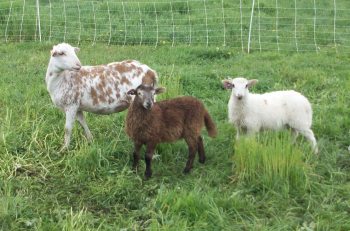
shedderOur Katahdins are all in various states of shedding off their winter hair coats. This is #10 and her ram lamb. You can see her winter coat peeling off her shoulders. Once they are done shedding, they look so clean and trim!

The birds have been appreciating the wool in the field, we often see them carrying it off for nesting material.

A few days ago, when I was out in the field moving fencing, a woman stopped by. She asked if I would move the dog house to be closerto the sheep, so that Bronte would be more likely to use it (she hasn’t gone near it that I know of).  The woman and I talked for a while, I told her a bit about the Maremma breed, and about Bronte and her life as a livestock guardian. In the end, she said, “ok, thank you, I feel better now.” I guess it’ll just take a lot of education to convince people that Bronte’s life isn’t so horrible after all!

Garden Beds

gardenbeds1We’ve been working on our new garden beds for the last several months. Kirk built these three raised beds using barn wood- these are floor joists from the second story. Though the boards have some damage, they are so thick, they should still last another 100 years!

We considered having topsoil brought in, but ended up using what we have here. Kirk scooped up soil outside of the barn, which was mostly made of old barn waste (manure + whatever else was in there  years ago).  Later I mixed in sand, which we also have in streaks throughout our property. Lastly, I added most of the layers of straw bedding from the ducks’ A-frame shelter, which had been composting since last fall.

I rototilled all this in. A lot of rocks ended up coming with the barn waste soil, as I think that manure was on top of what was originally a rock driveway; and in some places, we dug a bit too deep when scooping it up. So, we hand-picked as many rocks as we could. It looks pretty good, I think it will perform well.

We’ve planted peas, beans, artichokes, carrots, parsley, cilantro, brussel sprouts , green onions and lettuce. Many things are sprouting already. We plan to add some potatoes too. Kirk has also been making some terrace gardens on the hillside, and those contain tomatoes and strawberries.

We also plan on putting in a corn patch on top of the pen where the sheep stayed during flooding and lambing. We need to rototill that first! We’re keeping an eye on our neighbors, the Stockers, to see when they plant their corn. Ed Stocker, aka the “Corn King,” takes the temperature of the soil before choosing when to plant. He says that if you plant before it’s warm enough, the corn seeds just rot in the ground. They haven’t even plowed their corn field yet, so they must think it’s a ways off before it’ll be warm enough!

Poultry Houses

poultryaframes1I finally finished building my two new yuppie A-frame poultry houses a few weekends ago. I made one for chickens, with nest boxes and doors in the back for collecting eggs. The other one is just a plain night house. The two new houses are on the left, fully roofed; and the older, half-wire house is on the right.

I have the five duck hatchlings growing in the half-wire house. I bought some day-old Rhode Island Red chicks at the local feed store. I considered mail-ordering some, but have read a lot of the hatcheries are back-ordered quite a bit, and I was convinced I only needed a few. The feed store’s order was arriving right after I finished the houses.

I figured I only wanted about a dozen chickens, max, but asked for fifteen, figuring on some mortality. After I paid, the cashier said, “oh, you qualify for six free chicks based on the amount you spent today.” Ok, so now I have 21 chickens, and naturally, zero mortality! I think once you get them out of that mass-production environment into a roomy, warm pen with very accessible food and water, their individual odds of survivial go way up. Plus, I got there soon after their order had arrived, so got “fresh” chicks, and picked the most vigorous ones. I kept them in the house for the first several days until they were well established.chicks3

This was a pullet order, but I’m sort of hoping there will be a screw-up and at least one rooster in there, as I’d like fertile eggs. If not, I can buy one later. But these gals are a start, this fall, we should be able to start enjoying fresh chicken eggs, to augment the duck eggs. When they get a little bigger, I’ll teach them to range during the day, but go back into their house at night.

Bronte Has a House

doghouseI built this for our constituents, so they’ll feel happy that Bronte has a proper house. So far, she seems pretty disinterested in it, even in the rain. We’ll see if she feels like she needs it!

A few days ago, we looked out the kitchen window to see a tall man hopping over the locked gate in the pasture. I tell ya, people just seem to think they’re alone out there, and free to do whatever they want. I trotted down there, unnoticed by him, caught his attention as he was coaxing the dog (who was having nothing to do with him). I said, “excuse me, sir, would you like to tell me what you’re doing in our pasture?”

He suddenly became awkward and embarrassed. He claimed he was from the Sheriff’s office (shoot, later I wish I would have demanded to see his ID so I could have ratted him out for searching without a warrant!). He said was having dinner at a nearby restaurant when a woman talked him into checking up on the dog. She told him there was a puppy tied up in an abandoned field with no food, water or shelter.

He acknowledged that what she described was not at all what he saw, that he was picturing a tiny puppy tied on a short rope in squalid conditions. Not an 80-pound, woolly, well-fed guard dog in a 4-acre green pasture. He confirmed the dog looked healthy and not in conditions that are anywhere near what would be legally concerning. He groaned that people often call the Sheriff over supposed animal abuse cases that turn out to be false alarms, wasting their time that could be better spent on real crimes.

I offered to give him my phone number to pass on to the concerned citizen, if she wanted to talk. But he shook his head, and said he’s straighten her out. He apologized for trespassing, made his excuses and quickly skedaddled.

Duck Incubator Challenges

duckeggsLast year I tried incubating duck eggs twice, and my yields were extremely low. I found that most of the eggs grew to maturity, but never hatched. I concluded that the most likely cause of last year’s poor result was that I incubated in late spring and early summer, when outdoor temperatures were fluctuating wildly. Though I had the incubator in the house, the type of incubator I have is not thermostatically controlled (as far as I can tell)- it’s just controlled by a variable resistor, which you set at the beginning of the incubation period. As the house temperature rose and fell with the weather, I constantly struggled to keep the inside temperature of the incubator correct. So, this year I decided to incubate earlier in the year, when our house temperature remains more stable.

I also theorized that washing the eggs prior to incubation may have been detrimental. Large hatcheries do wash, to cut down on the risk of bacterial contamination on the egg surfaces. But, I figured I’d try mother nature’s approach this time instead. The eggs are naturally coated with a substance that prevents moisture loss, so it’s possible that it’s better to leave that on, despite the added risk of bacteria load. In the photo, you can see how dirty the eggs were. I use an egg-turning device, but this photo was taken after I removed that: the last three days before hatching, you stop turning the eggs so the ducklings can get into position for hatching.

Despite my new attempts, things still didn’t go well! I started out with about 40 eggs, withheld maybe six that didn’t appear fertile at the first candling. But I was expecting a good thirty ducklings out of this batch. What I got: five! A few hatched normally on their own on the due date or one day later. But then, nothing.

ducklinginshellHopefully this doesn’t sound too mad-scientist, but I cracked a few of them open by the third day of lateness, just to evaluate what was going on. Here is an interesting photo of a duckling in his shell, showing how folded-up they are- his foot is on top of his head! His neck and head are completely torqued around, parallel to his body.

In the upper right of the photo is his bill, and above that is where the air sac area of the egg was. So when they are ready to hatch, a small point on the end of the bill penetrates the membrane of the air cell, they starts to “pip” through the egg shell here. Then the baby will work his bill around the circumference of the shell and essentially crack open a “lid” and exit out of that “hatch” in the top of the egg shell. It’s amazing to think they can do all that maneuvering when they are this cramped in there!

What I found when I cracked these open was still-alive ducklings that had not yet completely absorbed their yolks into their abdomens. So, they were developmentally delayed. I believe this is most likely due to the incubation temperature being too low (though you can see I am using THREE thermometers in there for comparison- and all of them read a little different!).

Interestingly, one of these crack-opens survived just fine, what was left of his external yolk just dried up and scabbed over. But, the other ones, though they were wriggly and peeping for the first few minutes out of their shell, perished soon after.

So I gave the rest of the eggs more time, and one actually did hatch out five days late, but did not survive much after hatching. This seems to confirm what the books say: if they don’t hatch on time, within about 48 hours of when they’re due, forget about it. Just discard them, because whatever is left are weak and malformed birds. And hatch time can be hereditary, so you don’t want to keep and breed birds that don’t hatch on time.

fivebabyducksI also wonder if ducks aren’t harder to hatch than chickens? Their eggshells are much, much tougher; so I imagine if the hatchling is weakened at all, he just won’t make it out. And, the tiny point on the end of the duck bill meant for cracking the egg is indeed a very tiny point. Where chicken chicks are blessed with an entire pointy beak- a much better tool for tapping oneself out of an eggshell.

My other suspicion as to what is going on is humidity problems. The ducks that did hatch had trouble. Their shells stuck to them, their eyes were stuck shut, and they were just generally gummed up. We had to wash some of them with warm water to help them. This is not normal, ideally they crack out of their shells pretty cleanly, and are dry and fluffy in  few hours.

hygrometerSo, I’m going to try again. This time, I calibrated my cheap-o thermometers with our digital oven thermometer, and I do think the cheap-os are reading a little high (which explains why the last batch was late). And I purchased a hygrometer, which measures humidity in the air. I came to realize that these little doodads are inexpensive, and can be obtained at any cigar shop, made for cigar humidors. The cigar-style is just the right size and weight for using inside the incubator, and can just stick on the side.

So, I’ve got a batch of 36 eggs in there now, humming along at 99.5° at 55% humidity. I’m crossing my fingers that I’ve got it down now!

What to Feed the LGD

dogfoodI have not fed commercial kibble to my dogs in over a decade; I had long ago convinced myself from much reading and research that the ingredients in commercial food cannot be trusted. I enjoy making homemade food for my dogs, and my dogs seem very healthy for the effort.

So, when we got Bronte, the Livestock Guardian Dog, I was torn. How much homemade food would she eat, and how much work would it be to deliver her a fresh bowl of food every day? I decided to keep her on dog food at first, to be consistent with what she was eating before, and then ponder the question.

But, right away, I noticed she picked at her food, one kibble at a time. I always feel this is a sign that the dog’s body is complaining that the food is not right for the dog, and they are only driven to eat it when they are truly very hungry. Whereas, when you are eating things that are exactly what your body needs, generally they taste delicious. So, after a few days, I broke down and offered her a collie-style dinner. She gobbled it up.

So, now I’m compromising: I make her the same amount of raw food as the collies get, and then I back-fill with about another 5-6 cups of kibble. I’ve heard that LGDs don’t really eat that much, since they are generally lazy and have a slow metabolism. But, thus far, she is eating a lot! Hopefully it’s because she’s growing. The only saving grace is, at least she is tax deductible as a farm expense!

For the kibble, I’m trying to stick with the “better” brands. I have a lot of concerns about the massive and rapid growth stages the “giant” breeds go through, and feel that good nutrition is critical to weathering them through these stressful phases, to prevent lameness and permanent damage to their bones and joints. So, though I think it might be tempting to buy the “cheap stuff” for a dog that eats so much, I think this may be a financial disadvantage in the long run, if the dog ends up incurring a lot of health problems or has a shortened working life.

One challenge I’ve found when the dog is housed with the ram, he will eat her kibble, which is not desirable. So, I’ve found that putting it in water deters him, and renders the food still edible to the dog. If he ever learns to eat soggy kibble, I’m not sure what I’ll do.

Knowing that Bronte loves the raw food has been useful in training her to come to me as well. I have not found treats which will lure her, and she is going through a long and drawn out keepaway teenage phase. My longline idea helped some, but she keeps breaking it (or chewing it?). All she wants to do is dance and bounce around and woof at me, trying to enlist me in a game of chase and silliness. So, I give her about two minutes morning and evening to get her butt over to me and start eating her food, close enough for me to touch her. If she doesn’t, I take the food away with me, and try again later. She has skipped some meals, but I think she is getting the idea. Life is tough, but it’s imperative that she become more tame, and this is the only way I see to get that done!

Acute Alopecia in Lambs?

jacobewelambI’ll start by ending any suspense: the Jacob ewe lamb died last week. This in just a week after I first noticed there was a problem, and she was five weeks old. On a Saturday, I ear-tagged and weighed all the lambs.

All looked fine and healthy; albeit the Jacob lamb was still thin. She was not exhibiting as much weight gain as I’d like to see, or as the Katahdin lambs are demonstrating. She was 5lbs at birth, and was up to 9lbs 3 oz 30 days later. This, compared to #33’s triplet ewes, who all gained about the same amount of weight in just over two weeks.

And, if I compare her to the single ram lamb born in January: he gained fourteen lbs in a month, nearly tripling his birth weight! But, this was not unexpected, since her dam is severely underweight as well.

So, back to the problem: she looked fine that Saturday morning when I handled her. The following Monday night, she had large bald patches all over her hindquarters! Her wool was completely disadhered and peeling off! She was shivering-cold from the rain. I put a synthetic fleece jacket back on her (she wore this the first week of her life as well) and went inside to read. What could cause this?

None of my sheep books mentioned alopecia (hair loss) at all, except in the context of skin parasites. This was such a drastic change, surely it was not due to lice, keds or the like. I could see no sign of parasites, scabs or inflammation; and the rest of the flock is OK. So, I browsed the Internet looking for ideas. When you think of rapid hair loss, of course cancer chemotherapy is the first thing to come to mind, chemical toxicity is the most likely culprit. And, once I started thinking along that vein, I remember noticing her head in the mineral salt box when I was out there on Saturday. I think it is unusual for a young lamb to be interested in salt, if, ideally, she is getting everything she needs from nursing. alopecia

I found a few citations on the Web indicating that selenium (SE) toxicity can cause alopecia; though the citations were referring to sheep turned out on grass that was high in SE concentrations. We have low SE in our region, thus it is added to all sheep mineral supplements sold here, and is certainly present in mine. She could have OD’ed on the salt lick, out of a sense of desperation for minerals she was not getting in her milk. Alternatively, her dam may have OD’ed on it when she came to our place, if she did not have access to mineral supplements at Lynn’s; thus passing dangerously high concentrations of it in her milk.

This reference cites hair loss from SE toxicity. This reference cites salivation,  neurological distress, blindness, and convulsions. By Tuesday, she was foaming at the mouth, so OK, that’s symptom #2. Wednesday, she also seemed to show some “head palsy” movement, and an odd gait in the rear, so definitely some implication of neurological problems. And she was tired, she did not want to be up on her feet much.

The first Web citation suggests treating with a sulphate mixture, but this sounded too scary to me, especially since I had no way to confirm my diagnosis. The second citation says, “Treatment may be attempted, however the prognosis is guarded.”

In case you’re wondering: a vet call is usually not warranted for production animals. It sounds harsh, but these sheep are a  meat crop, with their final value being only around $200. And, to some extent, doing heroics to save weak animals is not wise: it certainly does not improve your breeding program, and usually does not result in a good meat animal. I would easily spend thousands of dollars to save my dogs, who are both farm help and treasured pets. But, the sheep must make do with whatever assistance I can offer them in facing Mother Nature’s challenges, without the benefit of hospitalization.

Since she seemed OK, other than the wool loss, I started with a homeopathic remedy for poison: Arsenicum. By Thursday, I was convinced she was on the mend, she was up and about, and though still a little palsy-ish, she seemed to be nursing, keeping up with the group and staying warm in her jacket. I stopped giving the remedy, as I’m always afraid to over-do homeopathy.

But, she must have taken a turn for the worse Saturday night in the cold rain. Sunday morning, she was flat on her side, convulsing, wet and cold. I also noticed a “weirdness” in one of her eyes: it looked like the eye of a deceased animal, cloudy and motionless. Blindness? I brought her in, warmed her in the bathtub, dried and re-jacketed her, and stuck her in a dog crate with blankets and a heating pad. I gave her a few more doses of Arsenicum, then switched to Belladonna (another homeopathic remedy) for the convulsions.

She improved slightly over several hours, the convulsions died down to subtle twitching, and she seemed more relaxed. I’d heard some rattle-ey breathing that morning, so then suspected pneumonia on top of everything else. So, I started her on penicillin, gave her a shot of vitamin B, and an oral dose of vitamin boost. She seemed to rally over the next 24 hours, but then crashed again, and ultimately died, a week after I first saw the wool loss.

So, the “prognosis guarded” warning was right. Though she seemed to fight hard, if this was a mineral overdose, it was probably too much for her kidneys, especially in her malnourished state. I’d be curious to learn if others have seen this manifestation before, or if anyone has an alternate guess as to the cause, since I couldn’t find a lot of written help on this set of bizarre symptoms.

As for me, I’m definitely going to think twice about taking in any poorly conditioned animals in the future! At least since this Jacob ewe was a gift, if I invest a lot of feed in re-conditioning her, she may still be worth it next fall when she’s bred again, if she can produce vigorous twins next year. But I think it’s a classic demonstration of how critical maternal nutrition is to the success of the offspring!