Food Poisoning Slows Progress

Kirk and I both got food poisoning, of course, there is now way to know for sure what the source is. Kirk became very sick Friday night, was up all night, and then slept all day Saturday and marginally recovered. I was mildly ill Saturday and thought I had escaped the full brunt of it that he had. But Sunday night, I repeated his Friday night, so Monday I was pretty shot.

So, that has interrupted my big plans for a productive three day weekend. That, and work interruptions. I did get a few things done though, I weed-whacked the septic drain field. And I ran a lot of errands.

I am ready to mow the center field, but realized the brush cutter needs maintenance, its blades have come loose. It turns out, it needs a 1-11/16″ socket to tighten the bolts, a wrench won’t work because there is no way to brace the rotary part so it won’t turn under the torque from the wrench. So, after calling around, I found a socket at Napa in town. That, plus an extension was $75! I was able to borrow a 1″ bar from my dad, but will probably need to get one of those too. I am finding that the tractor, though easy to work on, requires a whole set of specialized tools of its own.

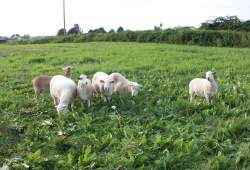
I found an ad today from some sheep farmers who are liqudiating their flock of Wensleydale sheep. They have potentially fourteen of them left, including a very nice ram. I was really set on hair sheep, because I’ve always heard that it’s hard to find shearers and the market for wool is drying up as fewer and fewer people hand-spin. But, I talked to this woman today, and it sounds like the sheep more than pay for themselves, that their wool is highly valued (if you can find a good shearer). She is emailing me more complete information on the animals.

So, maybe I would consider wool sheep after all, it sounds like a nice opportunity to take over an already well-planned breeding program. She was very helpful and shared a lot of information on how she markets the wool and runs her operation. The downside is, they are expensive animals, I would really lose sleep if I lost any to coyotes etc. Food for thought!

Have Fence, Need Sheep

New view from house.

I have been so busy lately. In trying to take three-day weekends in July and August to get more farm work done, I think it’s just resulted in my working longer hours during my four-day week at work to keep up! On Thursday, I had a 13 hour workday, including driving time! 😛 This morning I had to remote log-in to fix a software build breakage I caused- so much for sleeping in. I am thankful I can do it from home, however, that is sure a convenience.

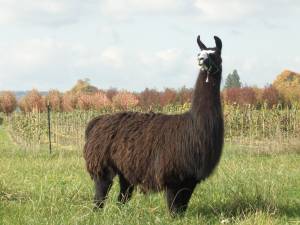
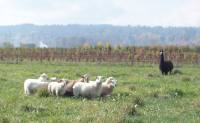
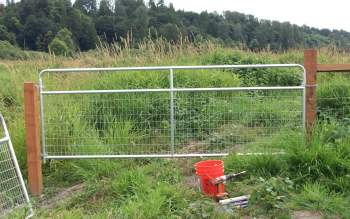
My plan for the remainder of the weekend is to take Monday off too, and mostly work on the farm. The first field is officially fully fenced and ready for animals- so that’s another task, is finding someone who has sheep to sell! I would prefer to buy eight pregnant Katahdin ewes, but we’ll see what I can find. I am also considering a llama, that would hopefully serve as a guardian.

Other goals for the weekend: weed-whack the septic drain field, mow the middle field, smooth the driveway by the house and order gravel for it. And, prepare for the fair, it starts next Thursday! My mom and I are meeting tomorrow to print out the hundreds of pages of schedules, score sheet labels, armbands, “spirit of 4-H” voting ballots, and state fair entry forms necessary for the operation of our 4-H dog barn at the fair. I am looking forward to eating a Russian Pirozki or two! Yum! 🙂

Magpies, Swedish & One Cayuga

The photo above is the “new” view from the house-minus those scrappy, half-dead alder trees: Kirk cut them down last weekend. And, here is a photo of my purchased ducklings, now three weeks old and thriving. They are enjoying getting let outside in the grass, this is a new privilege this week. The two Swedish ducks have black on the backs of their necks, the solid black one is the Cayuga, and the other four are Magpies.


Week One Without Chessie

At the agility start line (Cloud 9 Photos)

I guess it’s been just a week since Chessie died, it already seems like longer than that. Though, it’ll be a while before I adjust to making only three bowls of food, counting only three heads when coming in from the field, and loading only three dogs in the van. I have a lot of his “personal affects”-for lack of a better term-left to put away or give away. Extra dog beds, bowls, gear specifically for him, like his big tracking harness. And, now might be a good time to re-configure my van, which has semi-permanently installed dog crates and competition gear, since that’s one less big crate that needs to be in there.

I am dealing with the loss better than I expected I would, I think I was preparing for a long time. But, that dog was still a huge part of my adult life, so I sure miss him all the same.

I went back through my photo album of competition photos, and through his competition record book. The first entries were in the summer of 1997, when he was four years old and I had been out of college one year. He earned his AKC “Pre-Trial Tested” herding title with three straight passes, and his “Companion Dog” obedience title with one failure and three back-to-back passes and two placements. I remember  that weekend: his first run out, there was a minute of terrible loudspeaker feedback noise, it panicked him-so typical of Chessie. The judge, Christopher Cornell, was so kind, and re-started our heel pattern to let us regroup, but Chessie could not get it together. I had many runs ruined due to Chessie’s fears of certain noises, and umbrellas. But, he also almost always scored well, and often placed.

My last competition notes are from less than three years ago, where we finished our UKC Agility Trial Champion. He was still very athletic and comfortable jumping at age twelve. His final roster of titles earned was impressive for just a dog pound rescue, he had a good show career. His full registered name ended up being:

U-ACH U-CDX Chases The Sun CDX PT MX AXJ

Left is one of my favorite photos of him and me together; we were waiting at the start line of an agility run in this picture. There was a delay, I had already tossed my leash aside, and I knelt down to make sure Chessie didn’t jump the line before the judge signaled his readiness. The photographer had a good eye for capturing moments of teamwork and closeness between dog and handler.

Herding Trial

Last weekend I competed in an AKC herding trial with both of my younger dogs, Maggie and Idgie. The trial was lovely, well-run and organized, the weather was sunny but not-to-hot, and the Whidbey Island farm where we stayed is always gorgeous. I love the drive to get there too. It’s a very nice weekend for camping in the trailer, and I rarely miss that trial because of it.


My dogs, however, didn’t perform as well as I might have hoped. Of course, it always comes down to one’s training; there is nobody to blame but the trainer! J


I ran Idgie on two different sheep courses- an open field course, and an arena course. She had nice outruns in the open field, but was way too pushy on both courses, moving the stock too quickly, which causes her to struggle to control them. And, she was “slicing”, or cornering too tightly, instead of offering nice “square flanks” where the dog’s turning does not affect the livestock’s course. Idgie ended up only passing one out of four runs, and her score was still not that great (though vastly better than last year at the same farm, so I guess she IS improving in some ways). But, I’ve hardly worked her on sheep in the last six months, so I guess I just need to brush her up on several things. She did call off nicely, every time, which I do appreciate. And, as always, she covers well—she will not lose an animal, which is something that many other handlers and other-breed owners cannot say about their dogs.


I only put Maggie on arena ducks, because she is struggling with flat outruns right now, as well as being able to listen to and process my commands while simultaneously using her brain to read and respond to the livestock. She worked hard on the ducks, and almost passed on Sunday. But, the ducks were very dogged from being worked at multiple trials during the season, and they were challenging for even the most experienced dogs.


Maggie does an excellent job of thinking on her own, she does not need me to tell her where to be or how to respond to stock movements, and she naturally gathers livestock together and moves them towards me if she is not given any instructions. Through much of her runs, I had few comments other than “good dog, wise choices.” I have worked hard with both dogs to teach them “intelligent disobedience” which is to override a command from me if they perceive that a different action should be taken. This is an important skill for a Border Collie, to be able to cover livestock in an open field, they cannot wait for us to tell them what to do or which way to go.


But, in young dogs, sometimes, they can take this freedom too liberally, it takes a long time to learn (and teach) good judgment. So, Maggie is going through a phase of using too much of her own judgment, and very frequently overrides my commands to push the stock in a direction I don’t prefer (usually she resists moving them away from me, as her gathering desire is very strong). So, we will have to work on that too. She is such a stylish worker though, I really hope I can craft her into a good trial dog.


So, I have my training work cut out for me. Hopefully getting my own sheep will really help. My fencing is just about done, so I’m staring to shop, hoping I can buy eight or so ewes in the near future.

Fencing Miscellany

I got a few new fencing supplies via mail order today. The first was a one-hander gate latch, a style I’ve admired at several friends’ farms, but could not find locally. It was hard to search for it on the web, as I didn’t really know what to call it. It’s just a simple hook for a chain, but it’s easy to operate with one hand, while being difficult for clever animals to nose open. I imagine it’s only suitable for small, man-sized gates, but those are the ones you most frequently go through with your  hands full, so it’s inconvenient to mess with a chain-around-post lock. I found these at Jeffers Livestock Supply, for $1.99 apiece. Nice!
 
From Kencove, I got a batch of “Wedge-Loc” brackets that allow you to use metal T-posts as diagonal and other kinds of braces. I am interested in using these for a small fenced area I have to create to protect the septic drain field from too much animal traffic and soil compaction. This area is probably only going to be about 60′ on a side, but I do still plan to tension the field fencing there, so I need some kind of corner bracing. Yet, I felt that full H-braces would probably be overkill on something like this. I thought these brackets looked clever, easy to install, and maybe cheaper than using wood, so I’ll give them a try. Though they are sold by many vendors, I couldn’t find a lot of personal testimony on the web to verify how well they work.

Wedge-Loc brackets

 I was interested to see they have an example of using their brackets to make little loafing shelters out of T-posts and a piece of plywood for a sloped roof. This might be convenient for rapidly making inexpensive and moveable weather shelters for small animals or livestock. Hmm, food for thought.

Chessie :: April, 1993 – July, 2008

Chessie waiting to get ducks from a take-pen
Chessie waiting to get ducks from a take-pen (Lucky Critters Photography)

 So, I did it. I was tearful all morning at work. The night before, I’d concentrated hard on thinking of what he would want, of asking him. I’m no animal telepathic, but my sense was that he was ready, and that he wanted to stay home, to stay on the farm. By lunchtime, I realized I just wasn’t going to make it through the day at work, so I headed for home. I told myself that I wasn’t 100% committed to it yet, and part of my mind was already trying to un-knit the decision. But, another part of me knew it was time to walk straight into my own suffering, and not shy from it any longer.  

When I got home, Chessie was up and about, and vaguely glad to see me, but mostly because he wanted me to help him back inside. He promptly laid down on his blanket in the hall and fell sound asleep. It was good to see him resting well. He was breathing very slow, a little labored, and became fairly unresponsive. He didn’t acknowledge petting much at all. Maybe he was already getting ready, I felt like he knew and that he was relieved.  


I was hoping to convince the vet to come out and do the procedure, so I wouldn’t have to disturb him. But they didn’t want to. I was concerned that it would distress him hauling him in the van, and that we’d have a battle to find a vein at the vet’s office. I didn’t want it to end that way. We ended up finding a friend who could do it for us, she came in the evening. Chessie was still asleep, and didn’t even seem to notice the needle, so it was very peaceful, very gentle.  

Kirk kindly dug a hole in the pasture using the tractor and got everything ready. We wrapped him in some worn cotton blankets and put him in the ground, in the rain, just before dark.  


This kind of burial is consistent with beliefs I’ve been developing over many years, based on a lot of reading and thinking. I object to complicated burial procedures, painted coffins, chemicals and the like-it’s not good for the environment, not natural. Cremation is also polluting, and I believe that it has the affect of delaying the grieving process. You don’t see the body; it comes back to you days or weeks later in an urn, such that your mind does not connect well with the reality of the loss. The one time I had a rescue foster dog euthanized and taken away, I had strange, irrational thoughts for weeks, momentary ideas that I’d un-do it, go get her, change my mind. I think sending the body away prolongs the denial part of the grieving process.  

So, for me, this burial at home, in simple, natural cotton blankets, is right with nature, a last act of ritual and caring, and very final in the mind. And, so it is done, and I think it was right. My final realization was only this: that he had no good days, not even any good hours, left ahead. So, though the time and place were arbitrary, it seemed there was no point in delaying any longer. Now, we can all move on, we can all rest well once again. 

So long Chessie, it was a good fifteen years, and I’m glad you got to enjoy some life on the farm before you left. I will miss you.

A Hard Day

I wrote this yesterday morning, partly as a way to think through my situation. But, I didn’t have the heart to post it then, it would have made it more “real” than I wanted at that moment.


Today I feel I am facing an excruciating decision. Chessie is doing worse and worse, and last night was miserable for us both. His decline is very slow, such that the increments are not noticeable. But, when I evaluate his overall quality of life now, and compare it to even just a few months ago: I see that there is virtually no quality left. Save eating, perhaps. He struggles to get up and lie down. Often he needs my help with both. The rest of the day, he shuffles around the yard (where he is left most of the day) in a daze.


He seems very senile, or otherwise mentally withdrawn. He barely acknowledges my presence, and no longer seems to take pleasure in being petted. He does not make eye contact, though I can tell he still sees. Sadly, I admit, much of my interaction with him is filled with frustration and impatience, over which I feel extremely guilty. I owe this dog compassionate care now, as he has been faithful to me all these years, and ever-tolerant of my mistakes and flaws. But, what I feel he deserves does not always show in my actions, when I’m struggling to help him get up and he is trying to bite me, or when he has just made a mess on the floor.


I searched the web a little bit for guidance on when it’s time to euthanize. This decision is so terribly weighty and fraught with ethical and spiritual complications! It is hard to think with a clear mind in times like this! Advice from others concludes: evaluate the animal’s quality of life, evaluate what’s stopping you from ending it, and use your best judgment on what seems “right.” And they always say “you’ll know when it’s time.” But I feel I  don’t know!


I don’t think I am selfishly hanging onto him for fear of losing him-in fact; honestly, I am ready for him to pass on. That is one natural aspect of age-related deterioration, is that the person, or animal that you once knew disappears. It gradually prepares you for the complete loss of having them in your life, because you’ve lost most of them before the actual death event occurs. This morning when I awoke from what little sleep we both got, I was praying to find him gone, it seemed like the time was so right after such a hard night. But, no, he awoke when I touched him.  


So, what’s stopping me from euthanasia? I think I am avoiding having to take the responsibility for it—I am wishing to be spared that burden by having him die a natural death. And yet, what remains is guilt that his passing may endure more suffering than is necessary, because I refuse to make this decision. So, I can’t win, no matter which path I choose, the emotional consequences for me seem the same. 


I have tried to evaluate what end-of-life suffering means from a spiritual or religious point of view. Of course, that is one of life’s greatest philosophical questions anyway. And most religions don’t give a lot of advice that pertains to animals, since ancient texts mostly address animals from the standpoint of eating them! The best we can do is presume that there is meaning in suffering, that it is part of the soul’s growth, or perhaps penance for past wrongs. It seems we must trust that suffering is necessary, and we must embrace it and accept it as part of our term here on earth. Dogs are generally very good at that. Possibly end-of-life suffering is also instrumental in readying someone for their own death, in helping them come to the conclusion that they want to pass on to leave their suffering behind.


So, I think that is why euthanasia is so very complicated—that as much as I dislike seeing another suffer, and would like to end that suffering—is it my right, or my duty, to do so? Am I interrupting some natural, meant-to-be process by declaring “I will not allow this suffering”? Am I short-circuiting his own spiritual preparation for leaving his earth by removing the choice from him, his body, or the divine?


But, it breaks my heart that he cried most of the night, I don’t know why, or what was bothering him. And that he’s having more and more nights like this. He just seemed like he could not get comfortable. And I left him in the dog yard this morning, crumpled against the fence where he semi-collapsed- still whining. I can’t guess what his day is like while I’m gone, if he rests, or if he suffers all day, if he finds shade and water, or if he just sits where he lands out of apathy. I don’t know what’s happening in his mind, if he knows where he is, if he knows what he wants, or what lies ahead, outside of the moment he’s in. I know he’ll be complaining when he sees me pull in at the end of the day, but no matter what I do to attempt to address his complaints, he rarely seems to settle and be satisfied.


So, it seems that the decision is before me, that I must take that next step and own this choice. Only I can do it. There is nothing left of the dog that once loved to run, chase, play, jump, learn and be with me. He is only a shadow now, which wanders through each day like a ghost, biding his time for that which neither he nor I can know. It seems the only thing to do is to be the escort that delivers him to that place as gracefully as possible now, hoping and praying it was the right thing for his gentle soul.


I had a vet/acupuncture appointment scheduled this evening anyway. Maybe it’s time. Maybe.

Chores and more chores

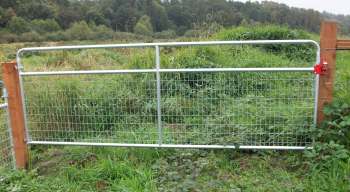
This weekend I did get to dabble a little on the fencing; I have all but one gate hung, and all of those now latch. There is just the tiniest bit of work left to make that field livestock-ready: one 12′ section of fence to stretch, one more gate, and fixing some “airspace” under one gate that’s on a slope. But, I didn’t get to that.

I had to finish the tractor’s 100 hour maintenance list, which takes some time-oil change, grease the fittings, check all the fluids, clean the air filter, etc. And, then I worked on field mowing, which is about a 4+ hour job for each of the two mowed fields. I got more than half of the main field done.

Mowing is pretty relaxing, it’s enjoyable to see a local hawk taking advantage of flushed mice. And the swallows go bananas over the insects that mowing excites– I had several dozen birds swerving and swooping all around me. They are so acrobatic, it’s amazing they don’t hit the tractor, or each other, when they are in such a feeding frenzy. I love the smell of mowing too, its reminiscent of my days driving pea harvesters as a summer job in college- a mix of diesel, hot machines, and cut greenery. The noise and the slow pace are mesmerizing, it’s a good time to contemplate many things.

Sunday my mom and I also worked on dog 4-H fair entries-it’s almost county fair time for us. Years ago, I wrote an Access database to track all of the 200+ dog show entries for our 11-day fair, which helps with scheduling, score tabulation, prize calculation, and state fair qualification tracking. But, it requires about eight hours of data entry before the fair to transfer paper entries into electronic records-worth it for the time it saves in the office during the fair, when things are hectic.

Of course, I’m the only volunteer resource who knows how to really use the database, so I’ve signed up for a lifetime commitment at database maintenence, I think! But, I enjoy helping, and I enjoy the fair. Next year, I strive to make Excel spreadsheets where each 4-H leader can type in their own data, that would really save me time, as I could just import it.

Kirk has asked me about ten times about the Nubian goats at the fair, whether there will be some for sale at the Open Show. He has his heart set on a black Nubian doe. Our friend Lori also loves animals and goats, and aspires to own one, but doesn’t yet have the place for one. So, she offered to “fund” one that we’d house, and she could visit. We could use a blackberry eater that could be tethered on the slopes during the day to help with clearing. So, that may be a next project: making a night pen for a goat to stay safe so that we can add to the growing menagerie.

Kirk has made tons of progress on barn wood cleanup, I’ll have to snap a picture soon. This week, I have to finish mowing, and then prepare for one last herding trial trip for this year. Friday I’m headed to a beatiful farm on Whidbey Island, and will camp there in the trailer for the weekend during the trial.

New Ducks, Take Two

New Ducks
New Ducks

On Friday, I picked up the newly ordered ducks from Privett Hatchery. Several people went in on an order of twenty or so ducks, so it saved us a few dollars each in shipping. I also thought it would save me a weekday trip to the Post Office during business hours, but it turned out they arrived on my day off anyway. In retrospect, it would have been simpler to have ordered my own, as I could have done the minimum of ten and not had the following difficulties…

We had a lot of trouble differentiating the breeds. The order contained (or was supposed to contain) straight-run Cresteds, Mallards, Magpies, Cayugas, Runners, Swedish, and Buff Orpingtons. I was expecting the Swedish to be blue (that’s the only “acceptable” color, but they do have black and silver in their gene pool), but all but a few solid yellow ducks, and the obvious Mallards, appeared to be black. The Swedish could  have been mistaken for poorly marked Magpies, so it was difficult to pick them out for sure. If there were Runners and Cayugas in there, they all looked the same to us (but I suspect they were all Cayugas, because we just didn’t see any hint of Runner shape to any of them). 

The other point of confusion was that we had ordered all females. Most of the ducklings had red paint on their heads. But, a few had blue paint, which we supposed may indicate males. We called the hatchery for help in confirming this, but they told us paint at all meant they were females. Ok. The phone advice on breed comparison didn’t help, so we finally just took our best guess.

I think those hatcheries handle thousands of hatchlings, and  their accuracy isn’t real high when packing complicated orders. Their convention is to pack a few extra in an order as large as twenty, but they didn’t this time. And a LOT of the birds were not doing well, they were weak, with floppy heads. I imagine one can expect some mortality rate with shipping, heck, it’s gotta be hard on the birds.

New ducks
New ducks

But also when I got there, the birds were not in a hatcher with food and water in front of them to recover from the trip, but rather were out on the lawn with a half dozen kids playing with them like toys. I know when I was that age, I surely couldn’t resist baby animals, and it probably would be safe to play with home-hatched babies that had a perfect start. But, it may not have been the best thing for these ducks after a long shipping journey, to endure the stress of childrens’ exuberance, and be away from their food, water and heat source during waking hours. I felt relieved that the ones I took seemed to still be robust (since they are $5 apiece, after all!). But felt badly that the ones left behind were all destined to be kids’ pets, since probably some of them wouldn’t be making it.

My intention was to get a combo of Magpies, Runners and Swedish. I got some nicely marked black Magpies, the Swedish are also black, which is ok, but not what I expected. And, the one solid black one I ended up with, I think, is a Cayuga, not a Runner. I don’t want them because they don’t lay well (<100 eggs per year), they are more of a meat breed. But, supposedly their eggs are quite blue, so unless the Swedish lay similar looking eggs, hopefully I can just make sure this girl’s eggs all go into dog food, not baby production.

Here are some pics of the new babies. The Swedish have darker cheeks compared to the Magpies, that’s the subtle way to tell them apart, as far as I know. You can see the one all-black baby, that has a small yellow haze on the chest; that’s the suspected Cayuga. Maybe I’ll grow to like her even though she’s not a runner.

Ducks, ducks, and more ducks

I may appear to be obsessed with ducks lately, but I’m not, really! It’s only one small aspect of the farm I wish to grow, but it just happens to be the one going on right now! My third hatchling died a day after the others. <sigh> My guesses of what happened are:

1) the non-medicated poultry grower feed may have been mislabeled; medicated chicken feed can poison ducklings (and boy did their demise look like toxicity). So, as a precaution, I’m going to discard that bag of feed and will revert to just using my adult duck feed (which is really an adequate grower feed as well, at 20% protein).
2) the electrolyte solution I was using may have caused trouble; though I used it on the last batch of ducks with no harm. Many hatcheries and books recommend using electrolytes, but I noticed advice on Privett Hatchery’s website that they recommend against  it, especially in the first week. So, I’m going to skip out on that too.
3) The cilantro- I can’t imagine that being a problem, but just in case, I’m going to stick to very plain, and washed, greens.

I really want to build my flock now, I only have one hen left to lay, and I’m reluctant to use the incubator again until I have a way to control the room’s ambient temperature. So I decided purchasing some might be the best move, for the moment. On craigslist, I found a woman who wanted to go in on a hatchery order with some other people (to meet the minimum order size), so I opted to go with that.

Before those arrive, here is a nice photo of one of the last ducks hatching, just coming out of his shell.

Hatching duckling