 I’ll start by ending any suspense: the Jacob ewe lamb died last week. This in just a week after I first noticed there was a problem, and she was five weeks old. On a Saturday, I ear-tagged and weighed all the lambs.
All looked fine and healthy; albeit the Jacob lamb was still thin. She was not exhibiting as much weight gain as I’d like to see, or as the Katahdin lambs are demonstrating. She was 5lbs at birth, and was up to 9lbs 3 oz 30 days later. This, compared to #33’s triplet ewes, who all gained about the same amount of weight in just over two weeks.
And, if I compare her to the single ram lamb born in January: he gained fourteen lbs in a month, nearly tripling his birth weight! But, this was not unexpected, since her dam is severely underweight as well.
So, back to the problem: she looked fine that Saturday morning when I handled her. The following Monday night, she had large bald patches all over her hindquarters! Her wool was completely disadhered and peeling off! She was shivering-cold from the rain. I put a synthetic fleece jacket back on her (she wore this the first week of her life as well) and went inside to read. What could cause this?
None of my sheep books mentioned alopecia (hair loss) at all, except in the context of skin parasites. This was such a drastic change, surely it was not due to lice, keds or the like. I could see no sign of parasites, scabs or inflammation; and the rest of the flock is OK. So, I browsed the Internet looking for ideas. When you think of rapid hair loss, of course cancer chemotherapy is the first thing to come to mind, chemical toxicity is the most likely culprit. And, once I started thinking along that vein, I remember noticing her head in the mineral salt box when I was out there on Saturday. I think it is unusual for a young lamb to be interested in salt, if, ideally, she is getting everything she needs from nursing. 
I found a few citations on the Web indicating that selenium (SE) toxicity can cause alopecia; though the citations were referring to sheep turned out on grass that was high in SE concentrations. We have low SE in our region, thus it is added to all sheep mineral supplements sold here, and is certainly present in mine. She could have OD’ed on the salt lick, out of a sense of desperation for minerals she was not getting in her milk. Alternatively, her dam may have OD’ed on it when she came to our place, if she did not have access to mineral supplements at Lynn’s; thus passing dangerously high concentrations of it in her milk.
This reference cites hair loss from SE toxicity. This reference cites salivation, neurological distress, blindness, and convulsions. By Tuesday, she was foaming at the mouth, so OK, that’s symptom #2. Wednesday, she also seemed to show some “head palsy” movement, and an odd gait in the rear, so definitely some implication of neurological problems. And she was tired, she did not want to be up on her feet much.
The first Web citation suggests treating with a sulphate mixture, but this sounded too scary to me, especially since I had no way to confirm my diagnosis. The second citation says, “Treatment may be attempted, however the prognosis is guarded.”
In case you’re wondering: a vet call is usually not warranted for production animals. It sounds harsh, but these sheep are a meat crop, with their final value being only around $200. And, to some extent, doing heroics to save weak animals is not wise: it certainly does not improve your breeding program, and usually does not result in a good meat animal. I would easily spend thousands of dollars to save my dogs, who are both farm help and treasured pets. But, the sheep must make do with whatever assistance I can offer them in facing Mother Nature’s challenges, without the benefit of hospitalization.
Since she seemed OK, other than the wool loss, I started with a homeopathic remedy for poison: Arsenicum. By Thursday, I was convinced she was on the mend, she was up and about, and though still a little palsy-ish, she seemed to be nursing, keeping up with the group and staying warm in her jacket. I stopped giving the remedy, as I’m always afraid to over-do homeopathy.
But, she must have taken a turn for the worse Saturday night in the cold rain. Sunday morning, she was flat on her side, convulsing, wet and cold. I also noticed a “weirdness” in one of her eyes: it looked like the eye of a deceased animal, cloudy and motionless. Blindness? I brought her in, warmed her in the bathtub, dried and re-jacketed her, and stuck her in a dog crate with blankets and a heating pad. I gave her a few more doses of Arsenicum, then switched to Belladonna (another homeopathic remedy) for the convulsions.
She improved slightly over several hours, the convulsions died down to subtle twitching, and she seemed more relaxed. I’d heard some rattle-ey breathing that morning, so then suspected pneumonia on top of everything else. So, I started her on penicillin, gave her a shot of vitamin B, and an oral dose of vitamin boost. She seemed to rally over the next 24 hours, but then crashed again, and ultimately died, a week after I first saw the wool loss.
So, the “prognosis guarded” warning was right. Though she seemed to fight hard, if this was a mineral overdose, it was probably too much for her kidneys, especially in her malnourished state. I’d be curious to learn if others have seen this manifestation before, or if anyone has an alternate guess as to the cause, since I couldn’t find a lot of written help on this set of bizarre symptoms.
As for me, I’m definitely going to think twice about taking in any poorly conditioned animals in the future! At least since this Jacob ewe was a gift, if I invest a lot of feed in re-conditioning her, she may still be worth it next fall when she’s bred again, if she can produce vigorous twins next year. But I think it’s a classic demonstration of how critical maternal nutrition is to the success of the offspring!
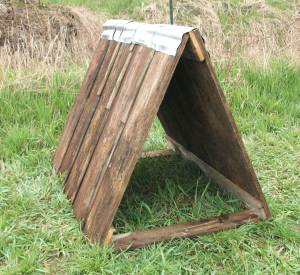 I built this for our constituents, so they’ll feel happy that Bronte has a proper house. So far, she seems pretty disinterested in it, even in the rain. We’ll see if she feels like she needs it!
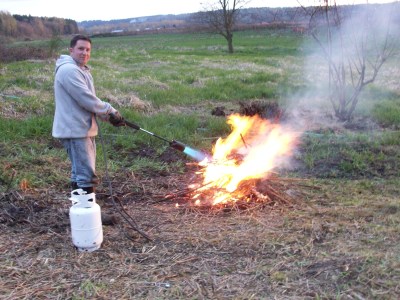 Kirk got this new toy today- it’s called “The Inferno”. He looks pretty happy with it. 🙂 If anyone needs anything lit, he’ll be right there- no job too small!
 Last year I tried incubating duck eggs twice, and my yields were extremely low. I found that most of the eggs grew to maturity, but never hatched. I concluded that the most likely cause of last year’s poor result was that I incubated in late spring and early summer, when outdoor temperatures were fluctuating wildly. Though I had the incubator in the house, the type of incubator I have is not thermostatically controlled (as far as I can tell)- it’s just controlled by a variable resistor, which you set at the beginning of the incubation period. As the house temperature rose and fell with the weather, I constantly struggled to keep the inside temperature of the incubator correct. So, this year I decided to incubate earlier in the year, when our house temperature remains more stable.
 Hopefully this doesn’t sound too mad-scientist, but I cracked a few of them open by the third day of lateness, just to evaluate what was going on. Here is an interesting photo of a duckling in his shell, showing how folded-up they are- his foot is on top of his head! His neck and head are completely torqued around, parallel to his body.
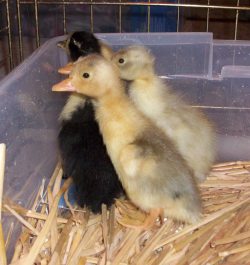 I also wonder if ducks aren’t harder to hatch than chickens? Their eggshells are much, much tougher; so I imagine if the hatchling is weakened at all, he just won’t make it out. And, the tiny point on the end of the duck bill meant for cracking the egg is indeed a very tiny point. Where chicken chicks are blessed with an entire pointy beak- a much better tool for tapping oneself out of an eggshell.
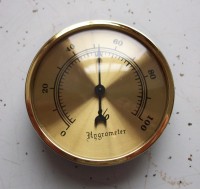 So, I’m going to try again. This time, I calibrated my cheap-o thermometers with our digital oven thermometer, and I do think the cheap-os are reading a little high (which explains why the last batch was late). And I purchased a hygrometer, which measures humidity in the air. I came to realize that these little doodads are inexpensive, and can be obtained at any cigar shop, made for cigar humidors. The cigar-style is just the right size and weight for using inside the incubator, and can just stick on the side.
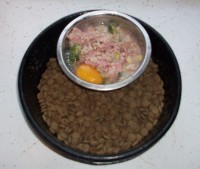 I have not fed commercial kibble to my dogs in over a decade; I had long ago convinced myself from much reading and research that the ingredients in commercial food cannot be trusted. I enjoy
  I sheared the Jacob ewe this last week. I started by using my electric horse clippers, but found them to be way too slow. I’m not sure if the blades were dull, or whether they were just not the right kind for sheep shearing. But they definitely did not perform like I’ve seen in the movies when sheep shearing is featured! I finished the job with old fashioned hand shears. It was a lot of work, I’m grateful I only had small animal one to do.
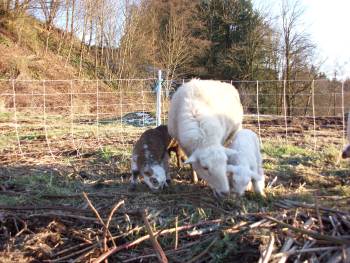
 Here is a photo of her in January, pre-shearing. She had two year’s worth of wool on her. I discarded the wool, it was fully of blackberry vine thorns and crud. Though she has nice fiber, I think it needs to be cleaner to be marketable. An I need to learn to be a better shearer!
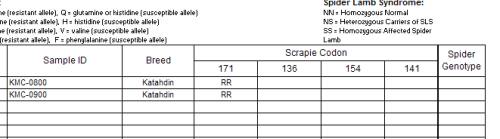 I got my scrapie DNA test results back already- wow, both rams are “RR”! That’s pretty cool news. I think what I’m going to do is keep them both for this fall’s breeding cycle, and split the ewes between them, so that I have a more diverse lineage next spring.
 A sneaky person posted this, and another similar homemade sign, out by our pasture this week. My favorite part is the one about the bed. 🙂 Seriously, it is a double-edged sword living on a well traveled road, with our pasture visible to passers-by. On one hand, we can sell as much lamb as we could ever produce, and we’ve made a lot of new friends.
 I am so impressed with the inexpensive nature of DNA testing for livestock: the going rate for a single sheep DNA test is just over ten dollars, and multiple companies are in competition for your business. Contrast this to the dog show world, where some researchers accept public funds to do DNA research.Then they get the help and cooperation of dog lovers and owners to collect samples for their studies. Then they turn around and patent their findings and sell the patent to a single DNA test company, who can then monopolize the test for seven years until the patent runs out.
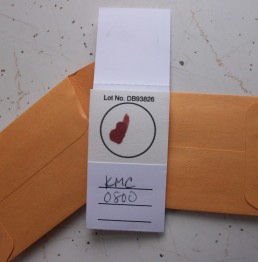 I decided I wanted to test two of our rams for the scrapie resistance gene. Rams that are “RR” at codon 171 are valuable in that all of their offspring with either be “RR” or “QR,” both of which are considered resistant to scrapie. Hershey is our older ram, I am interested in his status. I did not castrate #900, who was born in January, thinking I may want to keep and breed him. He was sired by Jessica’s ram, #650, so is unrelated to all the sheep I have (except his mother, of course). And, #650 is “RR” and also is a very nice ram, so capturing his genetics may be desirable. So, I’m testing those two rams before deciding on my breeding plans for this fall.