Blog

Outdoor Duck Snack Hut

duckfeedhutI built this poultry feeder A-frame a week or so ago. I used old barn wood this time. I don’t often find ways to recycle the barn wood, because it’s so dimensionally gigantic, dense and heavy compared to modern lumber, that even the tiniest structure weighs too much. Right now, we want everything to be move-able since we don’t know where all our permanent structures are going to go. But, this worked ok: made from barn siding and roof pieces, I think it “only” weighs about 50 pounds!

As you can see, I’m sticking with the A-frame theme, I just like the way they look, how easy they go together, how stable they are in the wind, and that they use less lumber than a cube. This thing I kind of free-handed, I didn’t do any measuring, I just eyeballed how it should go together based on the size of the feeder.

My plan here was to move the duck (and soon to be chicken) feeding station out into the yard. Since the ducks are nicely conditioned to free range by day, but go into their house at night, they no longer need a feeder in their shelter. And, that means they don’t need water in there either (ducks will choke themselves if they can eat grain but have no water with which to wash it down). The end result- less mess in their night shelter, and less frequent cleaning for me to do!

I am really pleased with the way things are working out with the ducks. I worried about predation during the day, since coyotes and eagles are ever-present and ducks are pretty helpless and not too brainy. But, we’ve only had one duck disappear in daytime in the last year and a half. So, knock on wood, they seem to be reasonably safe as long as they’re penned at night. I can stand a small percentage loss, as long as the predators don’t make a habit of it!

The ducks’ free-ranging during the day offers many benefits: they need less purchased feed, they eradicate slugs, they have a healthier diet, their eggs are richer, they stay cleaner and nicer-looking, and they are happier. Though they manage to hide a few eggs from me while they’re out and about, for the most part, they lay early in the morning in their pen. So, I’m satisfied with my egg yield, and am getting enough egg buyers now that the ducks are at least breaking even. What mystery eggs I do find in the yard go into the dog food. The best part is the slug patrol: I have a horrible slug phobia, so the ducks are worth their weight in gold in keeping the yard slug-free!

Poor, Monstrously Big #33

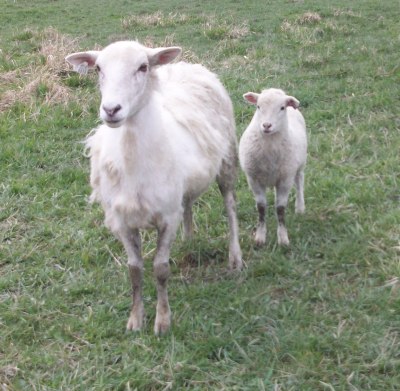
big33Look at this girl! This is #33, the quirkiest, dorkiest, homeliest of our sheep; and also our favorite! She doesn’t take any guff from the dogs, and if there is  Border Collie anywhere outside, #33 sticks to our legs like glue. She knows where the safety zone lies!

I was convinced a month and a half ago that she was due to lamb any minute! She is as big as a hippo, and has been bagged up all this time. Her udder could rival any dairy cow. She is six years old, and kind of saggy and baggy, so it’s hard to tell if the fetuses have moved downward or not, whereas on younger svelte ewes, it’s easier to see when they are dropping into birthing position.

She ran with a ram before I bought her on September 21st, so I thought for sure she would have been bred by him, and would have lambed in January like the other ewe did who came with her.

But, she is now past the time frame where her lambs could have belonged to him. Even by the largest time table I’ve seen published for sheep: 140-159 days, her last day to have produced his lambs would have been February 26th. I first exposed her to our ram on October 6th, so the likely earliest date for them was Saturday. There was a small window where I was nervous, if she would have lambed midweek, I would have felt unsure who the daddy really was- I should have waited a little longer to let Hershey loose. But, she has gone long enough now that I know for sure they belong to Hershey!

I’m taking bets there are three of them in there! When she stands, she is very lop-sided. Poor thing, she is literally going to feel 30 pounds lighter when she unloads those babies!

New Portable Hotwire System

hotwiresetupLast week I received a large order from Premier Supplies: 320 feet of portable “Electronet” fencing, and a portable fence charger with a solar panel. My long-term plan for this fencing was to help with rotational grazing and cleaving up our pastures into smaller sections. But, the short-term need was to be able to fence the dog in such a way that she can guard the sheep, but not wrestle with the lambs!

So, here they all are, in their temporary “feedlot” conditions. This little pen’s original purpose was to wait out any floods or potential floods, it is up on the hill near the house. But, it became a lifesaver when the coyotes became a problem, and the small quarters were necessary for the dog and sheep to become acquainted. With the arrival of the hotwire, I was able to make a “moat” around the center pen, so the ewes and lambs can be in there, and the dog surrounds them in an outer circle. It’s nice to have lambing happening close to the house, so I can monitor them frequently.

I put the ram in with the dog, so she’d have some company. She gets upset if she’s segregated from the sheep, or even some of the sheep, and spends her time trying to figure out how to reunite with them. This small adjustment in her space was also an attempt to gradually introduce her to the hotwire concept, in a familiar area, to reduce the trauma of it. Dogs often have a very hard time with electric shock, but it will be a necessary part of her environment, so she must learn about it!

We had one more lamb today, and the remaining three ewes should lamb any time. Once that is done, I can move the whole shebang back down to the pasture, and fence the ewes and lambs inside hotwire until the lambs are big enough to contend with the dog. I can fence the dog in, too, if I feel like I can’t catch her. I’m still working on that part.

fencer1Here is the electric fence charger. It’s a rechargeable 12-volt battery, and the solar panel is more of a “booster” to help get a couple more days out of each charge. It’s supposed to last a week or two between chargings. The dog learned right quick to stay away from it, she is very afraid of it. And, the sheep are really too mellow to even challenge it. So, when I’m around, I can leave it turned off. But, at night, hopefully it’ll not only ensure the sheep and the dog stay in, but should keep the coyotes out.

So far, I like the Electronet. It was very quick and easy to set up. I’ll have to comment again the first time I take it up and move it, whether I manage to keep it from becoming a tangled mess! It does sag a bit on uneven ground, which makes it touch the grass more, which will shorten the battery’s life. But, overall, I think it’s a great tool, and will give us a lot of flexibility in grazing different places on the property; and possibly offering to graze the neighboring property, which has recently been a challenge for the owners to maintain.

Lamb “Superman” Capes

lambcoatI love the Premier Supply online catalog, they have so many sensible products for farmers. These little fleece lamb coats are inexpensive and a great design for warming weak lambs. They have neck and leg holes and are quick to put on.

This little Jacob girl has been wearing hers since she was born last week, she was so small and unthrifty, I thought she could use some help. And it snowed during the week too, so I feel it really helped her focus her energy on gaining weight rather than keeping warm. I’ll probably remove it today, now that she’s caught up physically and it’s warmer out.

The fleece keeps its insulating power even when wet, and they wash and dry normally in the laundry. I plan to buy more next time I order, because it’s nice to be able to rotate a lot of them through the laundry. I think these blue ones look like Superman colors!

Lost a Little Lamb :-(

ramblambThe ram lamb born to the Jacob ewe on Saturday didn’t make it, sadly. As you may be able to see in the picture, both lambs were quite thin and unthrifty when they were born. I think the ewe might not have been carrying enough condition, and since I just got her, I haven’t had much time to increase her nutrition plane in preparation for lambing. The ewe lamb was the larger and more vigorous of the two.

My mom mentioned that our old Great Grandma Cogan, a North Dakota homesteader and lifelong farmer, always said that females are usually the survivors, and it’s more typical for the males to be the weak ones. (I think she meant in the animal kingdom, but I wouldn’t be surprised if Grandma was also making a parallel to humans! 😉 ). If that ‘s true, I don’t mind, because females are much more valuable in general- you only need so many boys, and the rest have to be sold or eaten! (In the animal kingdom, that is!)

Anyway, as I mentioned in my previous post, I figured out a bit late that this guy was just pretending he knew how to nurse. By late that night, it was evident he had lost too much energy to feed himself, and would certainly die without immediate intervention. So, this, of course, is where you dive in and do what you can- defying Mother Nature because it’s potentially a $200 animal that could be salvaged. But saving half-gone infants is always tricky, there is certainly an art to it. And there are many ways you can go wrong and just arrive at what was originally inevitable death anyway.

Since there was no suckling desire left, tube feeding was the only option. I felt pretty comfortable that I did the tube feeding correctly, but at one point when he was rallying on Sunday, I tried to get him to nurse with a nipple, and that was probably a mistake. Supposedly, the risk of milk aspiration is much higher with bottle feeding than tube feeding. And it was sometime after that when I noticed rattle-ey sounding breathing – a sign of impending pnuemonia from fluid in the lungs. And, he was developing scours- I probably gave him too much formula. Not to mention that since he did not get enough colostrum, he essentially had zero antibodies, so fighting any sort of infection is too big a challenge.

So, his odds were very slim whether I did nothing or tried something; and sure enough, Monday morning he took a turn for the worse and died that afternoon. I’m sad-I hope I never get over being sad seeing an animal die. But, it’s all part of the deal, nobody as 100% survival rates in breeding livestock. And without my intervention attempt, he still would have died.

The things I think I did right: having bottle and tube feeding equipment on hand, having both colostrum and regular milk replacer on hand, and everything in a bucket ready to go. I have lots of extra dog crates, pens, towels etc so I can always bring an animal right into the house for warmth and safety. As soon as I decided supplementation was necessary, I was able to get right on it. And I felt fairly confident in the tube feeding procedure.

The mistakes I think I made- not really getting under there to verify that the lambs were actually nursing. And possibly not taking action more quickly-though this is a hard one, because you don’t want to take one away from the ewe unnecessarily, as then you may be decreasing their odds of success once you start monkeying with them. And I think I fed him too much. That is the hardest part in supplementing, as I think the goal is to shoot for barely enough, because underfeeding is safer than overfeeding. This is where judgment and experience probably play a big role, I’m sure I’ll get better at it over time.

The good news is, the ewe and ewe lamb seem to be doing ok. They are the most important ones, anyway.

Bummer Lamb

bummerlambOne of the lambs born yesterday was a bummer- too weak to nurse. He fooled me for a while, because he was standing there with his head up in the udder, wagging his tail. But I finally figured out he wasn’t eating, while his sister was gaining weight and energy, he was remaining a skeleton. I tried to help him nurse late last night, and succeeded in getting a little colostrum in him and getting a decent sucking response. But by morning he was weak and cold, so he wasn’t able to stick with it.

So, in the house he came, to be tube fed. I tried my best to milk colostrum out of the ewe, and I got a little, but boy she has small teats and colustrum is thick! So, I resorted to powered colustrum, which isn’t nearly as good. This lamb has a very weak sucking impulse, so tube feeding is definitely a must. He seems to be gaining strength, so knock on wood, he might make it. I was able to get a little more milk out of the ewe today, to supplement the powdered stuff.

Tomorrow I’ll have to take him to work, in the car in a crate, so I can feed him every four hours, as is the requirement for the first three days. Not to mention getting up at 2am to do one middle-of-the-night feeding.

The Border Collies think this is the best-ever: livestock in the HOUSE! 😉 Maggie must be watched very carefully, as she would be quick to kill such a little thing. Gene, in a rare reversal of her normally obsessive herding instinct, is being very motherly. She has very strong maternal instincts, and is always trying to wash and lick everyone. She’s finally getting her wish- it’s actually a big help to have her wash the milky mouth of this baby, and his back end! There is nothing like a dog tongue for non-chafing washing of orphan babies, I’ve found!

New Twin Lambs Today

jacoblambsOur Jacob ewe lambed today- in broad daylight, which was cool. We didn’t notice her in labor at all this morning during feeding, later I saw her hanging her head a bit. But she was pretty subtle, the next time I looked up, she had a lamb on the ground! The second one came easily about 20 min later, I helped just a bit because one leg was backwards.

The LGD was so well behaved, curious, but gentle. She licked the lambs a lot. I did separate the ewe into her own jug tonight though, to help make sure both lambs eat. They look great- a ewe lamb and a ram!

Curtailing the Exuberance of a Young LGD

lgc_withjugOur livestock guardian dog  (who still doesn’t have a name!) is doing pretty well. She’s definitely got the right stuff- big bark, loves the sheep, weatherproof coat, and  just lays around most of the day. But, right now, she is still incredibly SILLY- just like any four month old dog would be.

In general, she gets along well with the sheep, she likes them, and they don’t mind her. Their inter-species communication functions well on a basic level, they understand she means them no harm, and she seems to find them to be pleasant company. But where this breaks down is that she still wants to play like a young dog does, and she hopes they’ll want to as well! She has moments of high energy and exuberance, where she leaps about, grabs the sheeps’ body parts, and tries to get them to engage in a good old wrestle. Of course, another dog would gladly sign up for such a ruckus, but wrestling is just not in a sheep’s repertoire.

The adult sheep have been able to manage this so far, they just move away from her in irritation, or butt her to send her on her way. Though I’ve seen her tugging on their tails and ears, she hasn’t seemed to do damage to them. Her advances are purely good-hearted:  I don’t see any hint of prey drive going on, she honestly does just want to play with her “friends” and she’s disappointed when they flee. But, this has not been good for the lamb. He tends to just hunker down and try to wait out the rough play. At first, she just made a few small tooth marks in him. But eventually, she bit him up good in the hock, and now he is lame. So, I had to make a separate section of the pen for his mother and him.

I’ve tried a few other things, with limited success. First, I tied an empty milk jug to her collar, with the idea being when she leaps and pounces, it’ll bounce and hit her in the face, providing enough of an irritant to slow her down. This actually worked well for a few days, she was terrified of the thing, and sat stock still for about 24 hours. But, now she’s used to it, and though I do think it makes her walk more carefully, it doesn’t slow her down that much.

lambcreepThe second thing I tried was making a creep for the lamb to get into, that would keep the dog out. I made an open-ended tunnel out of a grid of wire, so that even if she did a bunker crawl in after him, he could exit the other end. I showed him this, and he seemed to “get it”- I often saw him sleeping in there, and the dog couldn’t do much to him. But, I  the ewes kept wrecking the tunnel. They are shedding now, and are itchy, and they found that cramming their huge, pregnant bodies in there made for a splendid all-over scratching tube. 😛 But then they’d get stuck in there, and brute-force their way out, wreaking havoc with my petite lamb hut.

So, for how, he’s segregated so his leg can heal, poor guy. I have ordered 320 feet of electronet and a battery + solar panel charger. That should arrive next week, allowing me to re-configure the sheep and dog areas a little. Everyone can have more room, and I can separate out the soon-to-lamb ewes from the dog. Just in time, as they’re due the first week in March!

Recycling Old Farm Junk

recycle1Our house, though newly-placed upon this lot, resides on a dairy farm that was homesteaded around 1885. Of course the original farm was much bigger, but our lot has/had the last remaining buildings from the old farm- the barn and the silo. The barn fell down last spring, after not having ever been re-roofed since it was built in 1902. What we have left is a major rubble pile, not just of barn wood, but of metal products of every type imaginable.

100 years of farming tends to produce a lot of stuff, and it is our aim to clean it up and get it out of here. I understand how farms get messy, because farmers are busy and tend to leave things lying around. But we’re determined that our farm not be a messy one, so we’ve been working hard to incrementally clean up this century-worth of junk. We made a big stride forward in the last two weeks, by making a trips to the dump, the appliance recyclers, and the metal recyclers.

We had two old and broken refrigerators that were in the barn. In our county, there is only one place you can bring those, and you must pay $20 per appliance (they then dismantle them, use the good parts in decent-shape appliances, and dispose of the rest safely). So, it was good to see those things gone. The barn was full of bathtubs that were used for water troughs, and there was an old truck bed lying out in the dirt. Those comprised one truckload for the recycler- this was 5/8 of a ton of steel, for which we were paid $35 (I think). We were just happy to get rid of it and have it be recycled, so the money was a bonus. We were excited to find a new metal recycling lot very close to us, so it’s a convenient trip (and always an interesting one, to witness that little-seen side of the world- all the junk our society creates, and where it goes…)

recycle2The second load of metal was 60lbs shy of a full ton, and they paid us more that time, I think we got $60-something (not sure why- better metal than bathtubs?). There was a little bit of everything in there- stove pipe, broken gates, barbed wire, bent T-posts, black iron pipe, elecrical wiring and breaker boxes, cables, gutters, and I don’t remember what else!

We took a full truckload to the dump-mostly of old black plastic and orange plastic fencing, a few things that were broken when the barn fell (like my almost-brand-new fiberglass extension ladders! 🙁 ) and miscellaneous crud that was in the barn and around the yard.

Our Isuzu NPR flatbed truck sure comes in handy for these types of chores, and the hydraulic lift gate on the back is marvelous for lifting heavy things. It sure felt good to get rid of that more than two tons of useless junk!

LGD Introductory Training

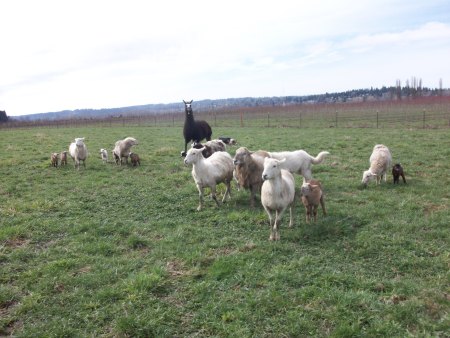
lgd2Here’s how I think it’s going to work integrating the LGD into the mix. I’m not confident that all will play out as planned. But I’ll have to be flexible and adjust the plan as I see how things are going, because I don’t really know how things will go!

Now:LGD is in a small pen with all the sheep. The idea being that she will be lonely and bond with them, not having much other company to prefer. And, that they will acclimate to her presence, having no way to get very far away from her. This part is going swimmingly- she already easily moves amongst them with little disturbance on their part, they tolerate her calmly, and she really seems to like them.

She is starting to try to play with them dog-style a little bit, which is not ideal, but expected. The lamb is already a good 20lbs, so should be able to remove himself from her silliness if he needs to, and the rest of them are big enough to butt her if she gets on their nerves. As the other ewes lamb, I’ll remove them to a separate pen for as long as I can, to give the lambs a chance to grow a little before having to contend with the dog.

The other good thing that’s happening now is the LGD is barking at night and barking at anything that approaches the pen. This should be putting the coyotes on notice that there is now a big dog in the picture. Hopefully they’ll just start steering clear of anyplace they hear her barking. And she’ll be gaining confidence that when she barks, she is able to make intruders leave.

ASAP: get that dog more tame and leash-broken. The 1st day she was here; she was stressed, and fairly demure. The 2nd day, she was feeling her loneliness, so was very solicitous of our attentions. But by the 3rd day, she’s bonded to the sheep, and is playing a bit of keep-away with people and getting very silly. Before she can leave that pen, she needs to come when she’s called and be able to walk reasonably on a leash. I suppose those are the only two people skills she’ll ever need to have!

Soon: catch the llama and move her up to the pen, so she can also acclimate to the dog. Fill in the gaps under the gates to make it harder for coyotes to get into the pasture.

At the end of the month: move the dog and all but three sheep back down to the pasture. Keep the three ewes that are due in March up by the house, with the llama, until they all lamb and can be turned back out. Since I don’t know when the Jacob ewe is due, I may let her take her chances pasture-lambing rather than have her potentially penned up all spring, waiting for her due date.

I’ve been planning to buy portable electro-net fencing in the future, so I can utilize it to do rotational grazing. That purchase is now higher priority, because I feel it’ll be safer to move the dog and sheep down into a smaller area within the big pasture. That way, the dog and sheep can spend more time bonding, the sheep won’t get too far away from the dog’s protection, and the hotwire will offer some protection from coyotes to all of them until things are more stabilized.