Blog

DNA Testing for Scrapie Resistence

dna_sampleI decided I wanted to test two of our rams for the scrapie resistance gene. Rams that are “RR” at codon 171 are valuable in that all of their offspring with either be “RR” or “QR,” both of which are considered resistant to scrapie. Hershey is our older ram, I am interested in his status. I did not castrate #900, who was born in January, thinking I may want to keep and breed him. He was sired by Jessica’s ram, #650, so is unrelated to all the sheep I have (except his mother, of course). And, #650 is “RR” and also is a very nice ram, so capturing his genetics may be desirable. So, I’m testing those two rams before deciding on my breeding plans for this fall.

The other two ram lambs born this year I castrated- they were born late enough that they’ll probably still be around when the ewes start going back into heat around August/September. I don’t want any accidental breedings, or the necessity of having to separate them; so they’ll be dedicated as butcher lambs. I figure that if I decide not to keep #900 for breeding, I’ll either sell or butcher him before that time frame, so it was safe to keep him intact. He is a lunker, a chubby boy, his mama is feeding him well!

I shopped around a bit on the web for DNA testing companies. I found three, but sadly, one appears to have gone out of business in the last week, I assume as a result of the tough economy. Of the remaining two, Biogenetic Services, offers customers the option of using blood “cards” instead of collecting blood in a vial/tube. I didn’t want to have to call a vet out, or haul the sheep to a vet just to collect a tiny bit of blood. I figured I could probably figure out how to draw blood on my own, but would still have to get a hold of the “purple top tubes” necessary to send blood in vial form. And then you have to pay for faster shipping, to keep the blood fresh.

By comparison, collecting a few drops of blood to put on a paper card is much easier to collect, and mail. Biogenetic Services sells the cards in batches of 15, for a dollar each, plus a few bucks S&H. I purchased a small box of lancets intended for diabetic use, so that I could be sure that each blood sample was clean. The instructions say you can also use the same piercing instrument and clean it with alcohol between animals, but there is risk of contamination. We are talking about such small quantities of blood here, that if you just get the tiniest bit of somebody else’s blood mixed in, it will invalidate the sample.

I spoke with the veterinarian on staff at Biogenetics, and he warned that even animals housed together in close quarters (like a feedlot) can often have each other’s blood on them. He recommended collecting from the ear, which I did. I found that piercing the tip of the ear produced the best blood drop, which I carefully squeezed from lower on the ear, to keep my hands away from the sample. I tried to make sure that I handled the card from the edges, and that the only thing that touched the target area of the card was the blood drop.

Then all that was left to do was label the cards, and send them off in the mail in a regular envelope! I’m anxious to learn the results!

The Patty Ruzzo Sneaky Dog Long Line

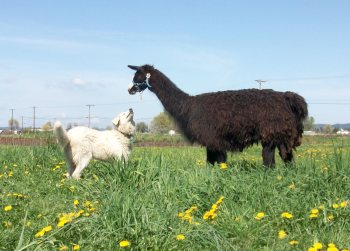
bronteandhershey2First of all, we finally agreed on a name for our Maremma: “Bronte” (spelled without the umlaut- because who wants to spell a dog’s name with an umlaut?). Here is a photo of her with the ram, taken by our neighbor Marla. She and the ram get on pretty well. If she tries to tug at his ears too much and gets on his nerves, he pushes her down and hurts her. So, they have their relationship sorted out! 🙂

You’ll note the long-line she’s wearing. This is a  great secret I learned long ago from Patty Ruzzo in a seminar. Patty is now passed on, but she was a well-known dog trainer who was highly successful in Obedience competition, and I learned many valuable things from her and think of her often.

We all know that puppies usually go through a “keep-away” age, where they start to learn they can run faster than we can, and that being caught is not fun. But, traditional store-bought dog long-lines used for controlling keep-away dogs are heavy and cumbersome. If you are training a dog to jump or herd, regular long-lines can get dangerously tangled on things. So this was Patty’s solution: grosgrain ribbon. This is a special kind of ribbed ribbon you can buy at a fabric store- it is quite strong, and inexpensive. Tie 10 yards of it to a brass clip, and you have a fabulous, lightweight long-line that “floats” along as the dog runs. It’s slippery so it rarely tangles with solid objects. And, if a dog really hits it hard, it breaks, saving their neck from serious injury.

This long-line is so lightweight the dog forgets he is wearing it. And, the best part is that you can step on it when you are calling him, and then just stand their casually like you haven’t done anything at all. He has no idea what has just occurred, and he starts to develop a superstitious belief that you are God-like, and can stop him in his tracks when you call him. Much better than stooping to pick up a heavy long-line, so the dog figures out “oh, if I run fast enough to get that long-line out of your reach, I’m home-free!” Instead, with this long-line, the dog starts to believe that when you call, there is no choice but to come.

So, this is what Bronte is wearing most of the time. She is still at a very silly age, and is easily intimidated by us, so when we are out in the pasture, she bounces around and woofs, trying to initiate the keepaway game, half afraid of being snagged. When she does this, I ingore it, and now and then, step on the long-line, catch her, pet and praise her then let her go.  The long-line is reasonably safe for her to wear in the pasture- there is not much for it to get stuck on. She has broken (or chewed?) it a couple of times, but I just re-tie it while she’s enjoying eating her dinner, and she is rarely the wiser. Her dinner is my best puppet string: she must eat it while I pet her if she wants to eat.

I used a line like this for many months on my “remedial” Border Collie, Gene. Gene was horrible about keepaway, for much of the first year of her life! Especially in a pasture with sheep. And, when Gene is frightened or upset, she flees, unlike most dogs who seek comfort from their owners when scared. I attribute this brilliant and simple invention to me eventually getting Gene under voice control, and now she has very good call-offs when she is working livestock, and will even reluctantly come to me when she is hurt or panicked.

So, I’m hoping, if it worked for Gene, it’ll work for Bronte! So far it seems to be doing the trick! Training an LGD is very different for me, as I only have a few minutes per day of interaction with her, as compared to a competition and house dog that gets many hours of intensive interaction per day. So, I have to make the most of every minute I’m in the pasture, to teach her the things she needs to know!

Sheep Are Back Out!

sheepinpastureLast weekend, we moved the sheep back down to the pasture to graze. The move almost went without mishap, except that at one point, the sheep drifted down to the end of the driveway by the road, and noticed the green alleyway by the tree farm. They decided to start strolling in that direction. I wasn’t able to get down there very fast with Maggie, and because that area is unfenced and close to the road, I didn’t want to send Maggie down there by herself.

As I carefully pursued them with Maggie, they drifted further and further, until they finally stopped, three properties down, where the properties border an elevated road. Fortunately, they stood there in indecision long enough for me to get around them with Maggie and nudge them back home. My heart was in my throat though, partly from running all that way, and partly because I feared that if they got onto the road, or Maggie disobeyed me and rushed to try to bring them, we could have had a disaster!electronet

The sheep are happily back in their graze now. The first few nights, I fence the sheep in an inner circle of hotwire, and the dog in an outer circle. The dog was very fearful about the move (Kirk actually carried her the whole way down to the field, because she cannot yet walk on a leash!). I was worried I wouldn’t be able to catch the dog once she was loose in that big area, and frightened.

But, after a few days, they all settled in. So, now the sheep are inside the hotwire, and the dog has the rest of the pasture to roam. The lambs are safe from the dog, and coyotes would have to make it past the dog, and the hotwire, to get to the sheep. Now, I have to move the hotwire rectangle every week or so to put the sheep on fresh grass, and let the worn spots rest.

This morning I moved the wire, in the photo you can see the left side is muddy and eaten down, and the right side is fresh green grass. The Premier Electronet fencing is all that it promised to be- easy to move and very effective at keeping in the sheep.

New Bridge

kirkbridgeKirk has been working on this bridge the last few weeks. It is made out of more barn wood-these boards were floor joists from the second story. The boards are huge and heavy, 2×12″ true dimension lumber, and sometimes bigger. The wood from the barn is funny, we know it was milled on site, and there are many inconsistent dimensions of lumber. When building something like this, it’s necessary to pick through the boards to find ones that are the same.

We have two drainage ditches that stretch across our pasture. There are culverts on one end of the pasture where you can cross the ditches, but they’re by the road. Last summer, Kirk drug a few of these barn joists down to the field to use as temporary bridges over the ditches. This way, we could walk straight across the fields, through the middle, which is a straighter path from the house. But, the bridges were a bit risky- narrow and often slippery.bridge

So here is his more permanent solution. This is the first one, he plans to start the second one soon. This barn lumber was very dark from over 100 years of weathering- it was never stained or painted. He ran it through the planer, and it’s amazing how just shaving off a few millimeters, it looks as clean as fresh-cut lumber! He is finishing it with Varathane, so it will be pretty fancy!

The old bridge is in the picture- this new one will be a bit safer for walking on when our hands our full of stuff!

New Duck/Chicken Tractors

chickentractorsI liked my original A-frame Duck Tractor design so much, that I’m building two more. One will be for chickens, however, with nest boxes in the back (ducks won’t use nest boxes, so the other A-frames are plain). I’m putting horizontal doors on the back wall, so that we can get eggs out of the nests without having to enter the A-frame.

The only thing I’m changing this time is I’m going to roof the whole structure, instead of putting chicken wire over half of it. I do like the original one I made, as it’s nice for baby poultry to be able to get some sunshine while they mature inside the pen. But since these will primarily be night houses for adult birds, I’d rather have the whole thing sheltered and dry.

The Last of the Lambs

801_whitelamb
White lamb with brown eyes, nose and ears!

Our last lambs were born today- two more ewe lambs, yeah! These belong to #801, who was a small yearling who did not look very big-in-the-belly, so she surprised us with twins! It’s a relief to have all the lambing over with, I plan to move all the sheep back down to the pasture on Saturday. The grass is growing, so the timing is good.

801_brownlamb2

Our lamb crop statistics this year, for what they’re worth with a small lot of sheep:

  • 200% lamb crop (6 ewes, 12 lambs born)
  • 17% mortality (2 lambs died)
  • 7 ewes, 3 rams 
  • All but one ewe lambed during the day-very nice!

Snow Day!

snowdayToday we had a short and intense snow storm. We’ve had a lot of warm weather recently, too, but March is always squirrely! It was bright and sunny when I took this picture at home after work. We’re hoping for more warm days, now that we can enjoy the extra hour of daylight to get stuff done in the evenings!

To Dock or Not to Dock

lambtailI’m not keen about tail docking on any animal, since it is a true amputation, and I have concerns about what it does to the animal’s physiology and whether they suffer from phantom limb syndrome. In sheep, short tail docking is definitely linked to greater incidence of rectal prolapse.

A couple of my Katahdins came with docked tails, and I don’t like them- it looks less clean to me, as “tail action” helps remove manure from their back ends. The ones that do have tails use them a lot, they are very expressive. I prefer the look of the natural tails, and am happy that I don’t have to dock any of my Katahdin lambs.

But, the single Jacob ewe was a different consideration. Lore has it that if you leave tails on wooled sheep, there is great danger of manure collection at the back end, which attracts fly eggs, then maggots, which will eventually eat flesh. So, when considering that, tail docking doesn’t seem so awful.

So, I docked this girl’s tail, using the banding method. I left the dock fairly long, maybe five joints, so hopefully she doesn’t have prolapse danger. I’m disappointed with the look though, as this thing atrophies and gets ready to fall off, I can see she’s not going to be nearly as cute as her long tail was! But it won’t show once she’s an adult and all wooley (like her filthy mama is in the background!).

Twin Lambs from Thursday

Here are photos of the twin lambs born last Thursday night. The first one was a ewe lamb, she’s kind of a dilute colored brown.brownewelamb


The second lamb was a ram, he’s the came-out-backwards guy. He seemed a bit weak that night, but by morning was up and about and nursing fine. He is also dilute brown, and has white socks on  his rear legs.

brownramlamb

#33’s The Champ!

spotted
#33's spotted ewe lamb

#33 had triplets today, all ewes- nice! They were on the ground when I got home from work. All look strong and healthy, and are nursing. I’m going to let her try to raise them all, her bag is so big, and she’s in pretty good condition, I think she can do it.

#33's brown ewe lamb

#33 was worrying me a bit in the last day or so, as she looked like she might prolapse. But, she didn’t, thankfully. Her lambs are white, brown and a spotted one, one six and the other two seven pounders.

#33's white ewe lamb

A few hours later, #107 had twins, a ewe and a ram, both nine pounders. I don’t have photos of those yet, it was after dark. The first one I pulled, holy cow, the ewe seemed to have trouble pushing that one. The lamb’s tongue was sticking out in the fashion of a badly formed or dead animal during the labor process, so I was relieved to see she was normal once out! The second one was a breeched presentation, but he came out easily enough. He seemed to have more trouble breathing and coming around,  I wonder if his bag and umbilical cord broke early, and he was without oxygen for a bit?

 
Big Boy Lamb
Mondo Lamb

On Monday, #802 had one mondo-sized singleton ram lamb,  10.5 pounds, a brown one. He was so fully formed, he was literally galloping about minutes after being born, with the mother desperately trying to keep up with him!

33_waistline1
New waistline

And lastly, here is #33’s waistline, postpartum. I bet she is glad to have those things outta there!

We  have one ewe left to lamb, I can’t wait for it to be done!