Blog

Sheep Software: I’ve Made My Choice!

ranchmanagerI mentioned a while back I was shopping for sheep management software and having trouble deciding on (and finding) a product. Since I have such a small flock to start with, it almost seemed silly to need software. But, I am a software engineer, after all, so I like software to organize things. I considered using an Excel spreadsheet to track my animals, and that would work, for a while anyway. But I just saw a lot of limitations to that approach– taking multiple notes on animals, keeping track of pedigrees, and assessing potential inbreeding would not be feasible in Excel.

I finally made myself a scoresheet on features I’d like to see in a flock management software package. #1 on my list was pedigree analysis, because that’s really hard to do on paper. I also wanted “smart ware” that would figure out when lambs are due, and then convert that breeding into a lamb automatically when I enter a birth date. I would have preferred it calculate breed percentages too. Then I needed it to track things: expenses, vet treatments, birth data, sales, purchases, and info from other breeders; as well as inventories and profit/loss data. I wanted a quality user interface where it was easy for me to find all the functions I needed, and good help screens. And, I thought it would be really cool to have it mesh with my Palm Pilot on my phone, so I could collect data in the field, and synch it with my PC.

I ended up evaluting three products first: FlockFiler, ZooEasy, and Sheep Breeder’s Notebook- they all came up most relevant on google searches. But, all three fell down on some important category, for me. FlockFiler’s only big strength was pedidgree analysis (but no inbreeding analysis in the basic version), and some animal tracking; but I just couldn’t jive with the UI. ZooEasy had a slick UI and many nice features, but it did not calculate lambing dates and seemed very bird-centric. SBN was a really nice product, but didn’t do any inbreeding analysis. So, I went back to searching more, and found Ranch Manager by Lion Edge Technologies.

This product does not come up well on google, I never would have found it except for their paid google ads, which appear occasionally. This makes me suspicious of a software product, if the authors have not done adequate search engine optimization (SEO), which should be really easy for software developers to figure out. But, having nothing to lose, I requested an evaluation copy of their product as well. I was enticed by the offering of the Palm Pilot addition, which the other products didn’t offer. But this product was also $200, more than I originally wanted to spend.

I ended up really liking their product, however. It does a nice job of inbreeding analysis, and tracks everything you’d want to know about an animal. The coolest part is that I can keep track of where animals reside, and as soon as I mark a ram as residing in the same pasture location as some ewes, it automatically assumes they’re bred and calcuates the due dates! When they lamb, I can just click a button to note that, and new animals are autmoatically populated with the right pedigree information from the breeding. All making my life easy when I have many more sheep and generations of sheep than I do now!

What finally sold me was that once I entered all the pedigrees of my animals, it showed me common ancestors I hadn’t noticed when poring over paper pedigrees. I don’t have an inbreeding problem-yet, but I would if I didn’t understand these relationships and breed away from them, rather than toward them. So, I bought it.

The Palm Pilot version is really cool, too. Now when I’m in the field, I can take notes about specific animals, and input data on lambs, and synch it with my PC version later. Now that’s modern farming! 🙂

New Wood Stove

woodstoveOur new wood stove was installed last week, but we can’t use it yet, as it’s missing the heat shield, which is on back-order. Kirk is chomping at the bit to use it, he has a whole stack of barn wood drying under a tarp, just waiting to get in that stove!

Our friends made the hearth, we think it turned out really well. We accidentally chipped  the front of it bringing it in, but they will come and repair it. They made it out of a wood structure  underneath, covered by cement backerboard, and then their own proprietary mix of cement and some other mystery stuff. They colored it to look like slate, which was our request, to match the black stove.

Deciding on its shape was tricky: as you can see, it comes right up to the trim on the French doors on the right, but then has a longer wall on the left. Our first attempt at the pattern, we drew a circle with the center being the corner of the wall. But we couldn’t make that address the clearance requirements in the front without having it encroach on the doorway and the room too much. Next we tried having the circle’s center abut 12″ out from the corner, but of course, still equidistant from both walls, thinking it needed to be symmetrical.

But, it turned out, it didn’t look symmetrical, even though it was; because  the long wall on the left created a visually imbalanced corner. So, we moved the circle center about 6″ to the left. If you study it closely, you can see this, that the circle arcs in more tightly on the right- it is not centered. But, we ended up with the look we wanted- it now seems to be balanced in the corner, oddly enough. Whereas before when it was truly centered, it appeared to be noticeably “off.” It’s funny how the eye can get confused.

We were relieved to get the hearth and see it work there in the corner– it’s always hard to be sure when using a paper template if you really have it right or not, or to envision how that’s going to translate into a real object. We are pleased with the result, the circle joins perfectly to the edge of the door trim. We will change these French doors later to be the style that open outside, instead of in. But, for now, we never use that left-hand door, so there is no risk of it whacking the hearth.

Kirk also sanded and refinishing the floor about a foot out from where the hearth would go. He was figuring, rightly so, that it would be a pain to sand up to that rounded edge later. The type of finish we put down is blend-able; so when we do the rest of the floor later, it should meet up just fine.

Real Estate Agents are Swimming Like Sharks Around Us

As I mentioned a few weeks ago, we put Kirk’s house on the market. We chose to use a flatlist service, where you pay a flat fee to get your house listed on the Northwest Multiple Listing Service (NWMLS), you get a “real” looking real estate sign, and a key lock box that real estate agents can use to get in and show the house. I, and several people I know, have used this kind of flat list approach in the past and have had excellent results. Kirk also sold a previous house of his without the help of an agent.

I am really good at software and graphics, and have made a beautiful flyer in PDF format, and also really nice online ads via postlets.com. The ad is everywhere we need/want it to be online. If we want to get it into any paper advertising, we could easily look up their advertising policies. But for now, we believe that the online tools are used by 99% of modern buyers, so we’re happy with the advertising outlets we are leveraging right now.

I used a digital fish-eye lens to photograph the house, so there are professional looking photos of every room. We are familiar with the Fair Housing Act laws as they apply to real estate advertising, The house is in impeccable shape– scrubbed clean, staged with nice furniture, and free of clutter. We did significant research on recent sales and keep a daily eye on new listings, so we feel confident the house is priced correctly. If we feel we need legal advice along the way, of course, we’d hire a real estate attorney, the only person who can legally give us legal advice. We have the schedule flexibility to show the house whenever needed.

So, why would we need a real estate agent to help us sell the house? I can’t think of any reasons, or anything they can offer that we don’t already have. And yet, it seems that many real estate agents still think we need them! 🙂 We are advertising the house on multiple for-sale-by-owner websites, and apparently hungry real estate agents prowl those sites, looking for potential clients. And they call– every day!

They are coy about their reason for calling at first, and get around to the bottom line slowly. And then, when Kirk tries to politely decline their sales pitch and offered services, they get combative. They engage him in an argument, trying to insist they can do something we can’t do. Sometimes they switch to insults, or probing and inappropriate questions, like wanting to know how much we owe on the house, or speculating that we must be facing foreclosure. Sometimes the conversations end unpleasantly. This, of course, is not the best sales tactic, so I’m not sure why anyone would employ it. And it’s driving Kirk crazy (it would me, too, except they have his phone number, not mine!).

I’ve  modified our online ads to gently, but firmly, say “real estate agents, we’re not looking for a seller’s agent, thanks. Please don’t call unless you are scheduling an appointment for a potential buyer to view the house.” But, these hungry real estate agents don’t read very well, or they are just mighty desperate, because they are still calling!

And what are they thinking, anyway? Does this really work, cold-calling FSBO owners and saying “hey, are you looking for a real estate agent?” Doesn’t everyone already know about two dozen real estate agents and have at least two in their family? If I were looking for one, I wouldn’t have to toss a stone very far to hit one. If I felt I needed one, trust me, I know whom to call. They’re in the phone book, and on the web, they’re everywhere. So are they expecting us to respond with some sigh of relief, and a reply of “oh my gosh! It’s so lucky you called, because we NEED a real estate agent, but had no idea how to find one!” Of course if we decided to  hire one, we’d hire someone we knew, someone we knew something about, and someone to whom we’d like our money to go. We don’t need to hire some stranger who cold-calls on the phone and tries to start an argument!

Sheep Check

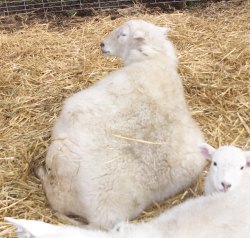
This weekend we had beautiful weather, so I went out to trim all the sheep’s feet again and check things out. The sheep all look very good, they are at good weights and seem generally healthy. A couple of the girls are looking big, I think those may already be four months along.

A couple of them still have foot rot, though none are currently showing lameness. This is frustrating. Part of me questions whether I should have had higher standards in only buying sheep with perfect feet. Certainly a lot of books and experts recommend this. But, sometimes I wonder if those experts are all in desert states! For, I don’t know anyone in our area who can claim zero foot rot on their place, our climate is just so damp and warm. I do think I can get them fixed with aggressive trimming, I’ve had good luck with it working on others’ animals at least. But, it is a drawback, for sure, to have this extra work to do.

A couple of the ewes have really good feet, so I do think there is some genetic component, that these two are resisting it better than the rest. I’ll have to note that when I decide which lambs to keep and cull this summer. But, #33 has the worst feet, and her daughter has the best feet- so they must not share that trait in common!

I also wonder about diet deficiencies. I recently read Pat Coleby’s Natural Sheep Care. Hers is an interesting book, that revolves almost solely around mineral supplementation to compensate for deficiencies in the soil. She makes a bold assertion that if you can get this corrected–either in your soil or with custom designed mineral supplements, that all problems (foot rot, parasites, birthing issues, wool quality problems, low production yields etc) should virtually disappear!

Intriguing notion indeed. I do believe that diet plays a big role in health, and we all know that unwise past farming practices have created deficiences in almost everybody’s soil. So, it’s on my to-do list, to have the soil tested, and figure out what I need to supplement and how I’m going to get it and offer it. Pat’s book asserts that just buying a general sheep mineral isn’t enough, that you need a custom one for your soil, so that the sheep eat what they crave/need, and don’t overdose on things they don’t need. She also asserts that most pastures are deficient in copper, and that most sheep need copper in their supplement. But, this goes against common advice, since there are issues with over-dosing sheep on copper; so all sheep supplements exclude it entirely. Food for thought!

Dog Show Van, Reasssembled

van1Last weekend, I finally finished re-assembling my cargo van with all of my dog show equipment. It took me several weeks to think of how to re-configure all of the stuff. I like this design, there is a lore more room for hauling things like lumber and hay now. It’ll be a little less convenient for unloading the heavy “ex-pens” (exercise pens), but I’m traveling less to shows these days, so that is less of a priority.

It is nice to have all of this stuff out of the living room and back into the van! Right now, I have half a bale of hay stored in there, left over from the flood plain drills. Since we are currently lacking a barn or garage, this is the best place to leave a half a bale of hay, for now. All in good time… van2

Wood Stove Plans

woodstovelocationWe are getting a wood stove. This was Kirk’s idea, mostly. I liked the idea of having one, but may not have tackled the project for a long time. But Kirk has been burning a lot of the old barn wood, and feeling badly that it could be better used to heat the house, instead of just for recreational burning. And, I think he just likes to burn! 😉 So, he organized a bid from a local fireplace store. We did not get multiple bids, because we know enough about this place to know they are good, and they are local. The price was reasonable, and we liked their stoves.

The hard part was deciding where the stove should go. Our old 1929 house has kind of a weird floor plan. A previous owner had a wood stove in the living room, but this made a stovepipe go up directly in the middle of the upstairs bedroom, which we did not desire. We ended up choosing to sacrifice some space in the was-dining room. This room was eaten up by the winder staircase that was added more recently, anyway, so it no longer has enough floor space to act like a dining room. 

It’s really become more of a strange foyer, I guess; since there are French doors exiting this room that we use constantly as a farm in-and-out door. This, unfortunately, brings a lot of dirt into the central part of the house (as can be seen in the photo!). Eventually, we’d like to repair the laundry room door (which is currently stuck shut) such that we can use that as the dirty farm door access, and leave our piles of boots in there. I think in the end, our floor plan will turn out to be very practical, if not unconventional. But, right now, everything in the house is just weird.

So, back to the stove. The floors are all old-growth fir, and we’ll eventually get around to refinishing them. We were tasked with choosing a hearth pad before the stove is delivered and installed. We considered the prefabricated ones the stove place sells. But, they were very boring tile jobs, with huge, unattractive grout lines. We wanted something a little more original. We honestly considered pouring some kind of concrete pad right on the floor, and a little web searching led us to believe this is a realistic option.

But, Kirk has a friend who does a lot of different fireplace design artwork, I guess you could call it. We ended up deciding to have this man make us a custom hearth pad. He makes his projects out of wood (in this case, 2×4’s, plywood and cement backer board), and then covers them with some kind of concrete product he has developed. It’s kind of a stucco look. We made him a paper pattern, and told him we wanted it to be slate-colored (to compliment the enable black vintage-looking stove); we’ll see what he comes up with!

This is a corner installation, and we settled on a round-shaped hearth. It had to arc back tight enough to not interfere with the French doors. But, of course, there are specs on how far out it must come from the front of the stove. So it was tricky figuring out what kind of circle arc to use. We ended up making the center of the circle offset from the corner and not 45° out of the corner. Oddly, a non-centered circle looked best in this corner, since the sides are not symmetrical– with a door on one side, and a plain wall on the other.

The picture shows some tape lines on the floor of different options we considered. We thought about embedding tile into the wood floor and running it in front of the door. But, we were a little afraid to make such a bold alteration, as it would have made a lot of work to change our minds later and put the fir floor back! And, our friend’s heath pad, we think, will give the stove more centerpiece attention and hopefully echo the rounded nature of the winder staircase we eventually plan to build.

Arrowhead Freeze-Free Faucet Frustration

faucetleakI have been struggling with a leaky faucet problem for maybe the last two or three months. This is an outdoor hose bib faucet, the kind with a long internal stem. These help prevent problems with freezing weather and broken pipes; as the stem closes off the water supply deep inside the house’s walls where it’s warmer, and the rest of the water drains out of the faucet when you shut it off.

The faucet was leaking where the arrow is pointing in the picture: right out of the tip of the stem, by the handle. This is a key piece of information, but I didn’t realize it at the time. I was annoyed with this whole situation, because the plumbing in this house is nearly brand new, only two years old! I didn’t expect to have plumbing repairs so soon!

I first tried tightening the two connections: the packing nut, and where the stem piece threads into the faucet unit. This didn’t  help. Next, I went to the store looking for replacement packing for the packing nut. But, I didn’t realize how many different designs there were, so I ended up coming home with the wrong size. I took the nut back to the store, and got a different packing. When I tried that at home, I realized that the packing nut’s threads were stripped. Back to the store, but they didn’t have that sized packing nut!

So, I tried a different local  hardware store. The “plumbing expert” there listened to my description of the problem, took a look at my stem, and at the packing nut, and concluded that my situation was hopeless. I bought a packing nut anyway, since they had one that fit. At home, I cleaned the threads out carefully, and got it to go back together nice and snug. But, the leak was still there.

Next I took it to Home Depot. I actually found a real expert there (this is rare for me), a by-trade plumber. I described my problem to him, too. He shook his head. He did mention a tidbit that would come in handy later, he said, “that there is an Arrowhead brand stem.” But, he also told me that they change the designs on these so frequently, that it’s usually impossible to get replacement parts. He asserted that I’d need to buy an entire new faucet assembly. And cautioned to replace it on a weekday, as people often break their copper pipe when trying to replace these, and then I’d want to call a plumber for backup.

Grumble. By this time, I had probably shut off the water to the house, and taken this thing apart, about a dozen times. I took it back home, put it together again, and sat there and watched the water drip… Then, I started to wonder: why is it coming out of the tip of the stem? And only when the water is turned on. How can that be? Though the stem is hollow (the handle screw threads into the hollow tip), it’s supposed to be sealed. The plug end of the stem is obviously working fine, because when the valve is shut off, no water is getting by.

faucetI took it apart again. I’m visualizing pressurized water flowing all around this stem on the way out of the faucet. And sure enough, tipping it on one end made water drain out of the inside of the stem. And, then, I see it. A tiny flaw in the solder joint on the stem. Very tiny. But, enough for pressurized water to want to get in there and leak out the other end. It must have taken two years for the water to slowly erode that flaw big enough to create a leak. I tried to solder it closed, but I’m no good at soldering, and I think fixing a tiny hole like that can be difficult, as there is not enough surface for the flux to bind to. It didn’t work. But now at least I knew what the real problem was: something that all three hardware store plumbing experts missed, despite my clearly explaining to all of them that the water was coming out of the tip!

I almost believed the Home Depot guy’s advice that I wouldn’t be able to find a replacement stem. But, I decided to give the Web a chance. And lucky for me that  Home Depot guy knew the brand name: thank you Home Depot guy! Lo and behold, McClendons Hardware had the fix, for $12: they carry a whole line of these Arrowhead stems! Wow! I was a little confused about the sizing, when I measured my stem, I concluded that it was a 6″ one. But, when the 6″ replacement arrived by mail, it was too long, so I had to return it. What I actually have, apparently, is a 4″ stem (I’m not sure how they measure these to get those numbers, but ok, whatever). So, last week, I finally got the right sized stem, and replaced it yesterday. And choirs of angels sang: no leak. Thank goodness!

Ladybug Invasion

ladybugsLast winter, the ladybugs decided that our house is a very nice winter vacation spot. I’m not sure how they select such sites, since this house is new to the area, it’s not like they’ve been doing it for ages. They’ve returned en force this year. They get in, definitely. And they don’t totally hibernate, they move about the house all winter, albeit lazily. So, they’re kind of everywhere: on my toothbrush, in my coffee, on my clothes. Sometimes one will fall off me at work!

But, I guess there are worse things that could infest a house. They’re not dirty, destructive, or harmful. And they are pretty. Ladybugs are sought-after pest preventatives, as they eat aphids and other things. Some people buy them for their yards and gardens. Imagine! Maybe I can start packaging them in my household and sell them to somebody else’s household!

I find it interesting how unique each one is. They are all a different shade of red or orange, and all have a unique number and positioning of their spots. For now, I’m not terribly annoyed with them, I feel we can co-exist in the house during the winter, since they do benevolent work during the summer. This photo is a grouping of them I found clustered on the side of the house, under the crawlspace cover.

Little Opossum, More Flood Prep, and Selling Stuff…

opossumI enjoyed spotting this little opossum in the duck pen one early morning a while back. He looked half-grown, maybe this year’s baby. I wonder if he (and maybe his kin) are partly responsible for the extraordinary amount of duck food I’ve been buying lately? I’ll have to remember to shut the door on that pen at night (the ducks are sleeping in the other pen, just because they are in that habit now).

Opossums are such funny behaving animals. I only noticed him because the dogs did, and yet, he just ignored their poking and prodding. And he wasn’t too disturbed by me either. It’s no wonder they get hit by cars all the time, they seem to be rather oblivious to big things moving around them.

We had to move the sheep again midweek, more flooding forecasted. This time, it was different. The ewes marched up the hill calmly and smartly, and penned easily. The ram decided he didn’t want to. I ended up having to halter him and drag him the whole way. Uff da, he is heavy when he doesn’t want to walk!  I imagine a few drivers-by found amusement to see me tugging him inch by inch, in the pouring-down rain.

And, the llama didn’t cooperate this time, she refused to come with. I ended up leaving her down there, during part of the danger time with the gate open so she could save herself if she needed to. I do believe llamas have retained enough wiliness that she’d probably be fine finding her own way up the hill if water started coming across the valley. I’m pretty sure sheep are not capable of that, however. I think if I work the dogs on her a little more, I can have her ready to move next time. She is just so new to the place, and very unsure of her safety.

I wrongly decided it would be ok to move the sheep back down after dark on Thursday night. It’s hard for me to be at home during daylight hours to do this, due to my work schedule and the short daylight we have right now. I think it would have worked fine, had Maggie not made a critical error. I retired her from working once the sheep were headed down the hill, as I figured they’d run down, and stop at the gate and wait. But, Maggie ignored my command and tried to cover them. I didn’t see her doing this in the dark. By herself, she caught up with them, split them, sent a couple sprinting down the driveway, and the rest into the drainage ditch!! By the time we arrived down there, the sheep had crawled out, but were stressed and wet. And it took us a few minutes to find the other two. The ram decided to be stubborn again, and was tangled in the blackberries, so we had to heave him out. But, in the end, we got them put away. And I know next time to bring a leash for my dog when I don’t want her to cover! 🙂

I’ve been trying to sell some things on craigslist and eBay, we have too much stuff from combining households. It feels good to clean out, somethings I’m just selling for the cost of shipping them, just to avoid throwing them away. So far, I’ve found takers for: some computer RAM, a PCMCIA LAN card, an old-fashioned 35mm film camera, a printer, a Dogloo, and a dog crate. There is much more to list, but I’m just doing a few at a time.

We’ve gotten three inquiries on the house sale, so that’s not too bad! Hopefully someone will fall in love with it.

Flood Plain Fire Drill

Our house is on a bench on a hillside, and it overlooks all of our pasture. The pasture itself is in the 100-year floodplain (the house is not). Though many people think that term means that the area floods once in one hundred years; the actual definition is that any given year, it has a 1% chance of flooding. That’s a little different! 🙂

The valley where our pasture lies is very rich and fertile bottom land that holds water all summer, thus it’s highly desirable for farming and grazing. This area was homesteaded in the 1880’s, and at that time, neighboring farmers collaborated to clear and drain what was, then, a marshland. So, this entire valley is cut with a network of very deep drainage ditches. These carry excess water to the nearby river, and lower the water table in the fields so they are suitable for agriculture.

Since that time, these cooperating farmers also build a network of river dikes, in an attempt to tame nature and minimize semiannual flooding in the valley. In the early years of these tries, the diking sometimes made flooding affects worse. If the dikes are not of an even height across the entire valley, when the river does exceed one dike section’s height, the concentrated force of all that water flow will do severe damage to the dike in that section and anything close by.

So, over time, these farmers and dike owners created cooperative, government-overseen organizations to manage the dikes. The chief goal is to make the dikes a consistent height, and to keep them under vigilant maintenence. We pay special taxes to the local flood control district, and they provide us with the service of managing the floodway. This also includes regular dredging of the drainage ditches in ours and our neighbors’ fields.

In recent history, our pasture was under water once in the ’70s, twice in the ’90s, and again two years ago. The last flood was an “overtopping” where the dikes all held, and the water simply exceeded their height and gently flowed over the top. That year, our pasture was under about five feet of water for several days. These are the most desirable types of flood, very calm and following the engineering designs laid out for them. If any portion of a dike ever breaches, then the force of the water will destroy a section of the dike, and general damage is much worse. This was true in the three earlier floods, with the one in the ’70s being probably the most devastating to the region.

We are especially lucky because we have a pump station nearby. So, when it does flood, as soon as the river receeds, the pumps can be turned on, and all the water sent back where it came from. This reduces the wait time for the fields to dry out, from weeks or months down to a few days. So, it’s not a bad deal– we work around a few floods, and in turn, we have some very rich agricultural land and much natural beauty that will never be filled with  housing developments.

hydrographThese days, working around the floods is actually not too inconvenient. Now we have water height and flow guages in many places along all rivers, and this data is automatically published to the Internet via various monitoring websites, most of it real-time. The graph to the left is the guage for the pump station near us. The National Weather Service monitors all of these guages and uses sophisticated computer modeling systems to predict and warn of potential flooding. Obviously, when major rains or snow melt are predicted, we know to start watching these guages!

Friday was one of those days: we’d had several days of rain already, and more predicted to be on the way. I started checking the guages a few times a day earlier in the week, and when the graph starts going up, I started checking them once an hour.

This is the first year where it really mattered, since we now have livestock down there. And, of course, I’d procrastinated a little bit on being truly ready. I had enough hog panels to make a pen “up top”, but they were still down in the pasture with the sheep, where I had fashioned a temporary pen for the ram. It was on my to-do list to bring those up to the house and get the pen ready, but we’d just been so busy with other things! And, I knew I’d have some time to react if it started raining.

I went to work Friday, but by noon, I could see the guage shooting upward at a pretty steep slope. If it kept on at that rate, it would flood around midnight that night. So, I headed home early. It took a couple of hours to dismantle the pen, bring it up, and rebuild it. I kept watching the graph, but by 2pm, it was not cresting. So, it was clear, the animals had to come up before dark. My dad and Kirk stayed up top near the pen, to help if needed. I took Maggie down the the field to round up the sheep.

The path the sheep needed to take was on the vacant neighboring property, across a culvert, and up a steep embankment. None of this is fenced, so it is essential to have a fast dog to help, or I could lose the sheep and not be able to run fast enough to stop them. I already knew the sheep would go ok, they are pretty calm and have been worked a little by the dogs. But, the llama was another story, I really didn’t know what to expect, and knew we might have to get creative!

The sheep were very reluctant to go through the gate, they are always fearful of new places. I got them through once, and left the llama behind, but I didn’t latch it properly, and they ended up spooking and pushing their way back through it. The second attempt left two sheep behind– #33 and  her lamb, along with the llama (#33 seems to really like the llama…). So, fine, I brought the five of them up, it was a little bumpy, but we did it, and with only a small amount of messing around, got them into the pen. It did help to have my dad and Kirk there, though I think now that I’ve done it once, I’d be confident enough to do it alone with the dog. When I went back for the other two, that was easy too. #33 comes to me when a dog is present, so I just put a lead rope on her, knowing  her lamb would follow. But, the llama… I got to the gate, took the sheep through, and tried to open it a crack to tempt the llama so I could grab her halter. Not happening. She would not come close enough.

But, by this time, I could see she was distressed. She did NOT want to be left behind from those sheep! She was making her funny llama sound, a sort of quiet, buzzing cry. She sounded very pathetic and she looked very concerned and torn. It is amazing how much she has bonded to them in such a short time. It became obvious that she would stay with those sheep no matter what. So, I figured, what the heck, even if I can’t catch her or get her in the pen, fine, I know she’ll stand right outside it all night. So, I just opened up the gate and had a loose llama free to roam the valley! 🙂

It felt a little risky, but I was right, she stuck to those sheep like glue. Once up top, I shoved the two sheep in the pen, had the dog hold them all to the back of the pen, and then opened the gate back up for the llama. She was very cautious, but it was easy to slowly edge her in. And that was that! They were penned in a small, 10×20 area for the night.

I figured the river wouldn’t actually flood, so I decided to wait and see. In the morning, I’d either have to buy some hay and set them up with water to wait out a real flood, or the river would have crested and they could go back down. The latter was true. As  you can see by the graph, the river crested late at night and was well on its way back down by morning. So, I had Gene help me take them back down. Same thing this time, I just concentrated on moving the sheep where I wanted them, and the llama went right along. They were happy to be back in their graze and comfort zone. And, we’re done with the flood plain fire drill until next time!