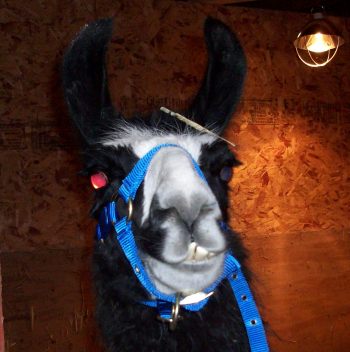
Our llama is an older lady, and we don’t know her whole history. Suffice to say it may not have been ideal. One thing I noticed as soon as we got her is that her teeth stuck out of her lips and grew at an odd angle. I’m not a llama expert, but llama teeth look like they’re configured the same as sheep- they have lower front teeth for grass cutting, that mesh with a hard upper dental plate/gum. Ideally, they should line up so that they can tear grass. Dolly’s clearly did not. I could see that when she grazed, she had to flip her head quite a bit to rip grass off, which is probably not efficient.
I’m not sure what causes this condition, but I suspect the primary cause may be no natural grazing, in an animal that’s fed hay and grain year-round (which I believe Dolly was before we got her). Eating hay and grain only requires gobbling up feed and grinding it with the back teeth, so the front teeth probably get no wear. The front teeth are designed by nature to continually grow, to compensate for incredible wear they’d normally experience from grazing. Dolly’s teeth were not only too long, however, they grew more horizontally than I would expect, and were curving to the side. I’m not sure what to think about that- perhaps it is congenital, or perhaps her too-tight halter played a role. Anyway, it needed to be fixed, because at our house, she needs to graze.
I searched for information on this condition, but found relatively little in my books at home and also on the Internet. Most mention of llama teeth is in relation to cutting fighting teeth off of male llamas- so at least I knew the teeth can be cut. I found this $219 value, intimidatingly large tooth cutting implement, the Tooth-A-Matic, but I can’t justify buying such a thing for possibly a one-time use. (It does look like it might be great if you found yourself needing to cut llama teeth very often!)
Finally I found this really helpful article, written by Eric Hoffman, complete with clear pictures, on using a Dremel tool to grind teeth down. Ok, that didn’t sound so technical once I read that. Dolly’s place on our farm is to protect our sheep investment (and she’s not doing a very good job of that even), and I really don’t want her to become a big investment in her own right. So I’d prefer to avoid vet bills if at all possible, and I am pretty comfortable doing a lot of basic medical things on animals. But, I’d avoided tackling her to do this kind of dentistry experiment, knowing that it would only add to her wariness of us, at a time when I want her to become more tame and trusting.
But, while she was in the barn recovering from her surfing stunt, I decided it was time. I didn’t want to let it go too long, because I was concerned about her ability to keep weight on if she cannot graze effectively. I didn’t know when I’d have her as a captive audience again, and I figured it would be better to do something “mean” to her in my parents’ barn, so at least she’d not associate it to being caught in our field.

So, I did it, and it turned out to be really easy! I had envisioned a possible rodeo with her bucking all over, and me and my Dremel tool going flying, resulting in me crying Uncle and calling a vet. But, not at all, she was very good. I used a metal grinder attachment for my Dremel, the kind with diamond-shaped scores along a wide cylinder. My mom helped me, and at first we did stick a broom handle in her mouth to help keep her lips and tongue out of the way. But at some point, it fell out and I ended up finishing the job just with my leather-gloved thumb holding her mouth open. She was surprisingly calm about the endeavor, and it only took a few minutes. I nicked her once in the lip somewhere just a little bit, such that there was a trickle of blood, but that was the worst of it.
I wasn’t able to get her teeth as aligned to her dental plate as I would have wished, because they are not growing at a vertical enough angle towards the plate to make a clear location of contact/meshing. And I didn’t want to take TOO much off- I wasn’t sure if I’d eventually hit the roots of the teeth and cause her pain. But, I was pretty satisfied with the result- at least they are all pretty even now, and closer to ideal. And now they only stick out of her lips a tiny bit, so she looks a little less dorky too! Poor girl, little by little, we may get her back into shape again.
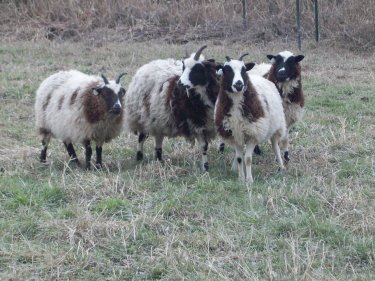 My friend Lynn has Jacob sheep. They are a “primitive” middle-Eastern breed known for their hardiness and self-sufficiency. Due to some recent changes in her lifestyle, she has less time for sheep now than she once did. So she gave us (for free!) four bred ewes to thin down her herd.
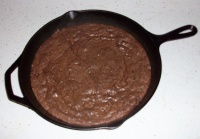 It has been a goal of mine for several years to swear off non-stick cookware. I believe that the potential health risks are just too concerning. Knowing that people have killed their pet birds by accidentally leaving a non-stick pan on the stove, creating toxic vapors, just makes me wonder what it does to me.
 I keep an eye on sheep listed on craigslist, mostly because it’s helpful to see the price ranges out there, and how cheap a buyer could get an animal compared to what I might be wanting to charge. My opinion of animals listed on craigslist is that they are generally “bottom of the barrel” quality; with a few listings maybe being lucky hits for nicer animals that people are just clearing out of their herd for acceptable reasons. In general, it is my opinion that breeders of good animals often don’t need to advertise, especially in a forum like craigslist, because demand for their animals is already pretty high via word-of-mouth.
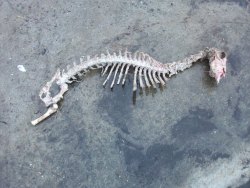 Well, it happened, and sooner than I wished: the coyotes snagged a sheep Thursday night. Of course I knew this was a possibility from the beginning, the coyotes howl in the valley every night, we see them occasionally, and I know neighbors lose livestock to them. They are definitely part of the fabric of this huge valley full of nature. Thus was the precaution of getting the llama. But, I had hopes that she’d be more effective.
 Here is the rest of the story on my final decision-making regarding scrapie programs. It turns out there is a lot written on scrapie and both the NSEP and SFCP, the information is spread out all over the place and not easy to find or understand. At first, I didn’t understand that there are two programs, so I found the phone number for my state veterinarian’s office, dialed them up and naively said “hi, I need some information on enrolling in the scrapie program.” Fortunately, I was immediately connected to Stacy Wozniak, one of the NSEP/SFCP coordinators in our state, and she was immensely helpful, and patient with my long email lists of questions. When she didn’t know the answer to a question, she found the expert who did. Over a couple of months, we got all my questions answered, and I was finally able to make an educated decision on what I wanted to do! I should also mention that Stacy was supportive and did not push me towards either option, but rather let me draw my own conclusions on what was right for me.
 For the last several months, I’ve been reading up on the subject of scrapie in sheep, and the government-mandated programs established with the goal of eradicating scrapie in our country. First, for the uninitiated, scrapie is the form of Transmissible Spongiform
  After last Thursday’s flood, our sheep are still “up top” in their little pen near the silo. They are getting tired of being up there, I’m sure. The timing was right to start graining the ewes, who are all getting big, so at least they have had something good happen in their little pen. When we’re home, we let them loose back there to graze.
 I went out to feed the sheep at 6am this morning, and this ram lamb was dry and up running around. I found a second lamb dead, she never got the sack off of him, so he likely suffocated. She is a yearling ewe, this is her first lambing, so we can forgive her mistake. Hopefully she’ll do better next year. She seems to be caring for the live lamb well, I checked both her teats, and they are working just fine. We saw him nurse twice today, and they seem well bonded.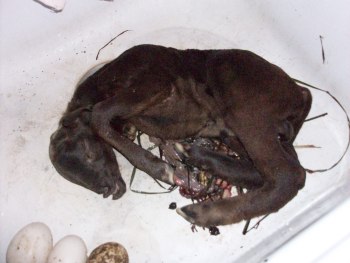
 Here is Kirk, kayaking in our pasture! It’s not too often you can say you are boating in your yard!