Here is Kirk, kayaking in our pasture! It’s not too often you can say you are boating in your yard!
His report of the sights out there: pumpkins everywhere, from our neighbor’s pumpkin patch farm. And the nursery tree farm, their irrigation tubes are also everywhere, in a huge tangled mess. Our ex-neighbor Nick’s port-a-potty is stuck on our fence- ugh! I’m hoping it wasn’t full of “stuff”, chemical or otherwise.
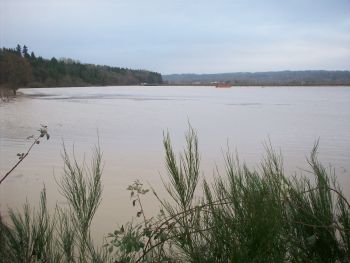
Below is another panoramic, this is taken from the hillside near our silo, looking across the valley. It’s really hard to capture the magnitude of the flooding in photographs, it’s really something you have to see in person to grasp just how MUCH water comes through. But, this does a pretty good job of showing how there is water as far as the eye can see. It literally does spread across the entire valley.
I stopped by my parents’ house Saturday to bring more feed for the llama and check out how she was doing. She is looking just fine. I could find no swellings, cuts or other damage to her, she’s not lame, not coughing, or anything. Amazing! My mom took this photo of me in the stall. You can see that once I am able to get a hold of her halter, she is calm. But she avoids it as best she can. I even managed to pick up one of her feet this time to look at her toenails, which I haven’t been able to do before. Her toenails look good, I don’t think they need any trimming.
While I was in the stall, I pointed out a dead rat to my mom, it was right next to the feed. My mom said, “hmm, that’s odd, I don’t remember seeing that this morning.” When she went to scoop it up with a shovel, it was still warm! So, I’m guessing Dolly stomped it? (They are not using poison at their house, so unless it died from somebody else’s poison, I’m guessing it was killed.) My parents were glad at the possibility of her paying some rent by killing rodents during her stay!
They must have turned on the pump station last night, because this morning there is a good 1-2 feet less water in our pasture. I can see fence posts, gates, nursery trees and the sheep shelters emerging. And the road is reappearing, now it looks like maybe only a 100-foot stretch is still under water. We saw a man out there wading in it with hip waders on, to see how deep it goes. It seemed to still be crotch-deep to him in the middle. People are starting to drive large tractors through it to access their homes. The road is much higher than the pasture though, so I think the pasture still has about three feet of water.
Our fence, from what I can see so far, looks good. Maybe a few T-posts bent, but the gate posts all held with their concrete feet. Though things could be worse in a dike breach, I’m glad to see that in a normal over-topping, the design seemed to have held up.
I got these from our neighbors Marla and Tiffany; Marla managed to capture more of the llama rescue on her cell phone camera. Thanks Marla!
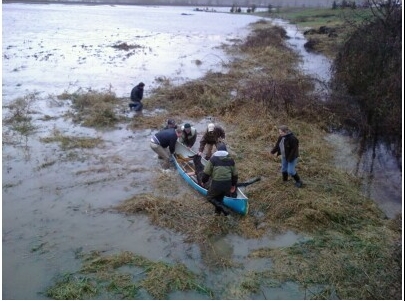
In the first photo, Dan had managed to guide the llama to a place where she could stand up, even though she was still in the water. But, at this point, she was not budging, and Dan was trying to manage the canoe, too. So three guys, including Kirk, rushed down to help in knee-deep cold water.
Once they discovered the llama was not going to walk on her own, and was acting pretty submissive, they decided to flip her into the canoe and see if they could tow her towards the road. She acquiesced pretty well, you can see here she’s mostly lying on her back in the canoe with her legs sticking in the air. By this photo, they had her close to the road and to the edge of the water. One guy, I think it’s Lee, is kneeling over, his back was killing him from all the lifting, and I imagine he was very cold!
Next they flipped her back out of the boat by rolling it over on its side. She was shivering, and pretty mentally checked-out by this point, so could not be convinced to stand up and walk on her own. You can see seven people helping in this photo, and there were several dozen more people on the road, many offering assistance and equipment. Ah, all our neighbors are obviously farmers and animal lovers-nobody could stand to see an animal in need!
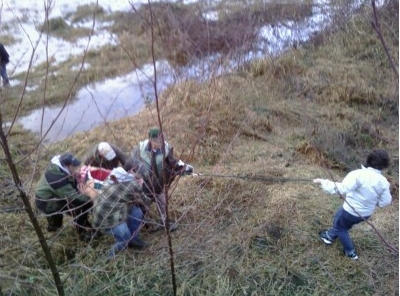
Lastly, here is a photo of one woman pulling on her leadrope while four guys lifted and carried her to the road. I helped lift her from behind part of the way too, until I went to get the van. Uff Dah, she was much heavier than I thought she would be! Once at the road, we were able to lift her into the side door of my cargo van so that she could sit kushed comfortably in the back and warm up.
Friday night update: Dolly Llama is doing fine so far. My mom reports she’s gotten her “attitude” back, and is quick to flatten her ears in annoyance when anybody comes into her stall! She’s eating hay and grain and seems to be alright. I imagine she’s bruised and sore, but she seems to be walking fine, so amazingly, nothing is broken!
Here are some photos Kirk took of how the flood looks. This is looking up at our house, which fortunately, is safe on the hill above the flood plane. In the foreground is our pasture, which is completely submerged. I feel grateful in that other than the llama incident, flooding is not too big of a deal for us. Just a small inconvenience taking longer routes to drive somewhere while our road is closed, and haying the sheep up top for a week or so. I moved the water trough and a few other items up out of the pasture this morning. I forgot a few wood fence posts that were stacked down there, but oh well, it was maybe $40 worth, they’ve probably floated away.
Others have it much worse, if their houses and other buildings have been damaged, if they lost animals, if they have to live somewhere else for a few weeks, and if they have to haul their livestock far to get it out of the floodway. I’m also grateful that we have a pump station in our dike district, so once the river recedes, we can get rid of our water much more quickly than areas that have to wait for it to evaporate or break up part of their dikes to re-drain their valleys. We really have it easy compared to many people in this state right now.
Next is a view looking across our pasture. In it, there is a single shipping container (the kind they put on the back of semi trucks). But, oh, there used to be two of those out there -where did the other one go? It floated away, and is now lodged way back in the weeds on the neighboring lot, across a drainage ditch, in a place where likely nobody will ever be able to retrieve it without cutting it into pieces.
I have to utter a little I-told-you-so to myself, because our ex-neighbor Nick had bought these things as a cheap way to have “instant buildings” on his property. I tried to tell him they weren’t a good idea in the flood plain, that the water would move them who-knows-where. But I could tell he thought I was a silly girl who didn’t know what she was talking about, and he insisted they’d be fine. I’m just glad the thing traveled the other way, and didn’t take out our brand new fence! And, it’s out of our valley view now, so at least we only have one tacky thing to look at. There was a ton of debris and freebie farm junk over there too, and most of that is now lodged in our fence. But now we can dispose of it, something I’ve been itching to do, but not feeling legal to before now!
Third is a view of the road disappearing into the flood waters. From here, the water goes for miles through pastureland. I can never really wrap my mind around how much water this is, to fill up an entire valley. This is the fourth flood I’ve seen here, and it is still amazing to me and everyone else here. Neighbors still all stand in awe when the water comes, everyone just gathers, stands and stares (or helps rescue a llama, when necessary!). And after the water goes, and I look out, I cannot re-envision the water or believe how high it once was. It just seems impossible.
Fourth is a closer view of how the water roils on the opposite side of the road. The county has re-designed this stretch of road more than once, in an effort to enable it to withstand this incredibly erosive water action. In previous floods, the waterfall action of the water would erode under the pavement and blow out the road, and it would take months to repair. Now, there is a concrete curve on that side, and wire baskets of rock underneath that. The cement curve helps guide the water over into a more graceful waterfall motion, so that it can’t start digging under the asphalt. And the wire baskets allow water to travel under the road, so that pressure can equalize on either side more quickly, to reduce the force on the road bed. This design seems to be working, it lasted through the 2006 flood, and seems to be holding up now. This is the rough waterall through which the llama took a tumble. The road sign in the photo has been knocked over from the current.
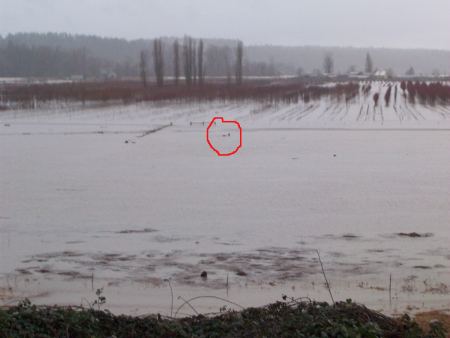
Llama is swimming, or is that the loch ness monster?
Today was a pretty challenging day! The flood gauges were getting high, and we tried to move the sheep last night, but they didn’t want to go out of the field in the dark. We waited til this morning, and I was able to move them smoothly and with little fanfare to their pen up by the house. Phew.
But, the llama was a different story. She has been getting more wilyas the weeks go on. We’ve caught her a couple of times, just handled her a little, and then let her go. But, each time, she remembers what we did last time and she won’t let us do that again. Today, she was not to be convinced to leave the pasture, let alone caught. I opened up all the gates and tried to push her through with Maggie. No go. Later, our neighbor Dan and both my parents came over– the four of us tried to make her go through a gate- any gate-no way. I brought sheep #33 down and tried to lure her up. She called to the sheep, but still refused to budge. If anyone would get within 100 feet of her, she’d just bolt past and run to the other end of the pasture. Running in front of her waving hands, etc did not work, she’d obviously run over someone if she had to, to get where she was going. She is one stubborn animal!
I went to work briefly this morning, but came home around 11 because flooding looked imminent. Sure enough, the dikes were just over-topping. The best I could hope for was that the llama’s wily instincts would kick in when the water stared flowing into the pasture, and she’d fiind an open gate, and head for higher ground and her sheep. The flood waters were proceeding really slowly across the valley for a couple of hours.
But then things turned for the worse, water started coming fast, and surrounded her in the pasture. She stayed put at a high spot until the water was up to her back, and then she started to swim. Our neighbor Dan brought out his canoe and went out to try to help her. By this time, water started rushing over the road and making a focal point of current, with a several-foot waterfall on the other side with rough-looking rapids.
The llama got caught up on the fence by the road for a few minutes, and as Dan tried to help her, she got free and was pulled by the current over the road. She almost gained her footing there in the shallower water, but the current got the best of her, and she went tumbling through the rapids, her skinny little legs kicking in the air upside-down. Ugh! It was hard to watch. There was a large crowd by this time, and we all gasped.
But she came right back up and started swimming on the other side. Dan re-launched his canoe on the other side of the road, reached her, and managed to to guide her near to the edge of the water where she could stand up. Kirk and several guys ran down to help. Dan had a leadrope on her halter. But that’s when she started to get stubborn again, or hypothermic and shock-ey, it’s hard to know which. She kept “kushing” or lying down, refusing to move. She was getting floppy, so the guys finally flipped her into the canoe upside-down and towed her to dry land! Keep in mind that they were all standing knee deep, and deeper, in very cold water! Kirk and Dan had hip-waders on, but some of the other guys were in tennis shoes and blue jeans! I was worried, but people seemed to be willing to risk their own lives to save this llama!
When they got her to the edge, a whole bunch of people helped carry her up to the road. Some people brought blankets and a horse blanket to warm her. We pushed and pulled and prodded, and she was not helping the whole way, she just wanted to lie down. I racked my brain to think of the quickest way we could warm her, and realized that my van was the answer– I could drive it right down to her, and crank up the heat, and we could warm her much quicker than any building. So, that’s what we did, with one last big heave-ho.
I put hot water bottles in her armpits and near her thighs. I put a heating pad under her chest, and Kirk ran a blow dryer on her head. There was a bale of hay in the van, and she started snacking within a few minutes, and then getting annoyed with us a few minutes after that, throwing her head around and laying her ears back. So some part of me thinks she was faking her hypothermia and she was actually fine, just tired and traumatized, and probably afraid of all those people. We left her in there for a few hours to continue to warm up and rest, until her skin was toasty-warm to the touch.
My parents rigged up a stall in their barn with lots of straw and two brooder lamps, and we left her there in the evening with the horse blanket draped over her. They said she seemed fine at 9pm when they checked on her. So, now I suppose the biggest concern would be if she aspirated water and is at risk for pneumonia or something. But she seems to be out of the woods. Probably just tired and bruised up.
There were some funny moments. One lady kept trying to feed her a carrot- but a carrot was the last thing she wanted after nearly dying! It’s funny what people do under stress, when they want desperately to help, or make things OK. And, a mouse was riding on her head while she was swimming, and later, a dead mouse fell out of her wool! There were mice swimming everywhere out there, and we even saw a salmon swim by!
Lucky llama that there were so many people there to help. It really took a crew, and Dan’s canoe, to pull it off. I’m not sure what her future will be with us– if she is this recalcitrant, she may not have a place at our farm. We need our livestock to move agreeably when there is a flood. I never expected to have an animal be so difficult to move or even get through a huge gate into a big, open space. I’m almost afraid to let her back out there in the pasture again, knowing there is no way to catch her or get her to leave the pasture. Oh, boy, we’ll see. At least I have a week or so to think, while the waters recede.
Meanwhile, we have ocean-front property; our house is safe on the hill, but we now look out on a valley full of water! This has been a wild weather year for Washington!
We live on a major migratory path for birds, so we get to enjoy a lot of them during the fall and winter. Lately there have been hundreds of Trumpeter Swans and Snow Geese coming through. They are noisy- day and night- but I enjoy the sound.
Last week in the snow, we encountered this bunch of snow geese in the pasture. My Border Collie Gene spotted them first, and started to walk up on them slowly, like a good working dog.
I lied her down so I could snap pictures of them on the grond, and then when I was ready, I asked her to walk up on them so they would flush, and got a few nice snapshots of them in flight. They are sure beautiful!
The snow was such an ordeal these last few weeks, our region is just not well-equipped to manage in this kind of weather. But it was so pretty, it’s worth the hassle, at least for a little while! Our animals are glad for the melt, however, I think the sheep really prefer fresh grass to hay. Kirk said today the llama was rolling gleefully on her back in the grass today, she seemed so happy to have it back!
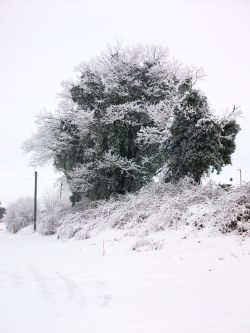
Wow, we have a lot of snow– at least for us. I think it’s about a foot deep. Which, I’m sure, seems trivial to people in the Midwest or the East. But in the Northwest, that is a ton– I don’t have many memories of there being this much snow here in my lifetime. We’ve had snow falling for the last week, and more in the forecast for the whole next week- incredible! Usually it doesn’t stick around more than a day or two before melting into a muddy slop. Here is a panoramic photo from the pasture, in which Maggie appears twice– she got in the frame more than once!
The temperatures aren’t bad– a few days it’s gotten into the teens, but it’s mostly hovering right around freezing. We got our first official complaint to animal control about our animals- from a well-meaning citizen who felt concerned for them. An animal control officer came out to investigate, and chuckled to himself, “well, the DO have wool, after all!” A friend of mine teased me that we should get wool coats for them!
It’s true, the sheep only have a tiny shelter out there, it may not seem like enough to we non-furry humans. But, sheep are amazingly hardy. We are giving them hay, but they are choosing to go paw through the snow to graze, and only picking the hay. (And I swear it’s not moldy or poor– this is a $19 fresh bale from the feed store!) They really look like they’ve grown more wool in the last week or two, they are quite bundled up and puffy. The llama has so much wool insulating her that snow accumulates on her back and stays there– it doesn’t melt! Once a day I break the ice out of their trough with a pickaxe, though I suspect they are getting their water from eating snow and not going to the trough.
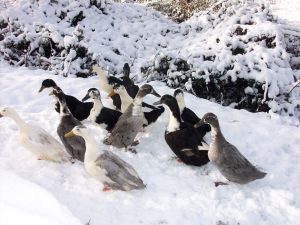
Our ducks seem equally unfased by the chilly weather. I put a heat lamp in their house, but they all slept as far away from it as they could get. Their ranging during the day is curtailed because it’s hard for them to walk, but they still get out in the morning, and still bathe when I give them fresh water! Ugh!
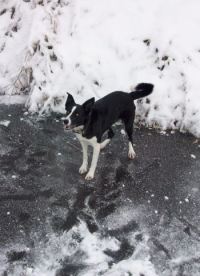
The dogs, of course, think the snow is fabulous. Here is a picture of Gene standing on ice in the ditches, barking like crazy. She seemed to know this was incongruous and was demanding our attention and skating all over like a silly, as if to say ” look at me! I’m walking on the water!” They so make us laugh with their cleverness and spunk. Poor Mr. Spanky is getting old, and walking through the snow and ice is harder for him, but he’s always game for it, he just takes it slow.
This month, I’m trying to learn about the differences between the mandatory and voluntary scrapie identification programs for sheep. The voluntary one is more rigorous, and limits what sheep you can bring into your flock, but it can make your sheep more marketable to others who are also in the voluntary program.
I think I want to go this route, but am not sure if I want to wait, to give myself a little more time to buy breeding animals that don’t come from other voluntary farms. I have a huge packet of information from the state veterinarian’s office that explains everything, but it’ s a lot to wade through! I see that most Katahdin breeders in my state who are members of the national registry association do not participate in the voluntary program. So, it seems it would really limit from whom I could buy sheep if I chose to enroll.
 Here is Kirk, kayaking in our pasture! It’s not too often you can say you are boating in your yard!
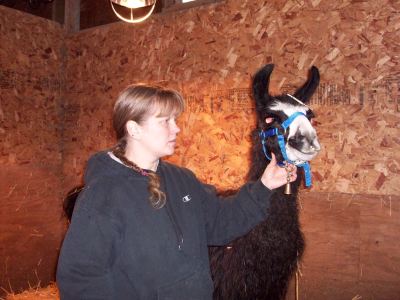 I stopped by my parents’ house Saturday to bring more feed for the llama and check out how she was doing. She is looking just fine. I could find no swellings, cuts or other damage to her, she’s not lame, not coughing, or anything. Amazing! My mom took this photo of me in the stall. You can see that once I am able to get a hold of her halter, she is calm. But she avoids it as best she can. I even managed to pick up one of her feet this time to look at her toenails, which I haven’t been able to do before. Her toenails look good, I don’t think they need any trimming.
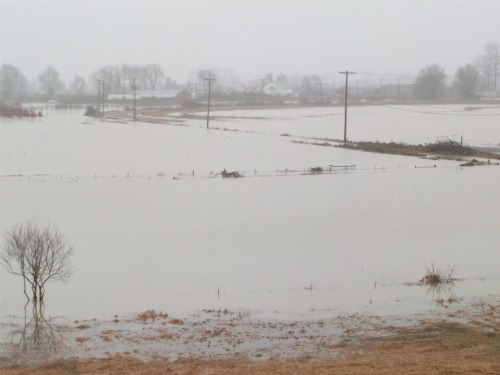 They must have turned on the pump station last night, because this morning there is a good 1-2 feet less water in our pasture. I can see fence posts, gates, nursery trees and the sheep shelters emerging. And the road is reappearing, now it looks like maybe only a 100-foot stretch is still under water. We saw a man out there wading in it with hip waders on, to see how deep it goes. It seemed to still be crotch-deep to him in the middle. People are starting to drive large tractors through it to access their homes. The road is much higher than the pasture though, so I think the pasture still has about three feet of water.

 And now, a little bit of summer. I can’t wait for the pastures and the sky to look like this again!


 We live on a major migratory path for birds, so we get to enjoy a lot of them during the fall and winter. Lately there have been hundreds of Trumpeter Swans and Snow Geese coming through. They are noisy- day and night- but I enjoy the sound.
 Wow, we have a lot of snow– at least for us. I think it’s about a foot deep. Which, I’m sure, seems trivial to people in the Midwest or the East. But in the Northwest, that is a ton– I don’t have many memories of there being this much snow here in my lifetime. We’ve had snow falling for the last week, and more in the forecast for the whole next week- incredible! Usually it doesn’t stick around more than a day or two before melting into a muddy slop. Here is a panoramic photo from the pasture, in which Maggie appears twice– she got in the frame more than once!
 The temperatures aren’t bad– a few days it’s gotten into the teens, but it’s mostly hovering right around freezing. We got our first official complaint to animal control about our animals- from a well-meaning citizen who felt concerned for them. An animal control officer came out to investigate, and chuckled to himself, “well, the DO have wool, after all!” A friend of mine teased me that we should get wool coats for them!
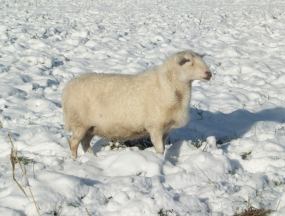 They really look like they’ve grown more wool in the last week or two, they are quite bundled up and puffy. The llama has so much wool insulating her that snow accumulates on her back and stays there– it doesn’t melt! Once a day I break the ice out of their trough with a pickaxe, though I suspect they are getting their water from eating snow and not going to the trough.