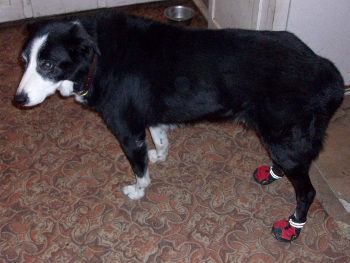
 Our eldest Border Collie, Spanky, is about thirteen years old (I’m not sure if his exact age because he’s a rescue, but I know he is at least that old). He is having the same problem many old dogs suffer- weak rear quarters. This, combined with our wood floors, make it very difficult for him to get up from lying down. He lacks the muscle strength and coordination to get traction. Sometimes he collapses midway, sprawling out like a frog, and would need assistance to get back up. It’s sad to see once-spry dogs suffer these old-age maladies, and I’m sure it impacts their quality of life. So, we’ve gotten him some shoes to help!
Author: fourfarmdogs
Country Living Expo & Cattlemen’s Winterschool
 Here is a plug for an upcoming event in Stanwood, WA that should be well worth attending. WSU’s Country Living Expo and Cattlemen’s Winterschool is an amazing array of 135 classes on all sorts of topics,a jam-packed day of learning, plus a prime rib lunch. The hardest part is choosing which classes to attend! 😛
Here is a sampling of some of the topics:
Fruit Tree Maintenance, Hands on Hay judging, Frisbee Dog Training, Growing Giant Pumpkins and Vegetables, Building Your Own Greenhouse, Native Plants for Wetland Restoration, Arc Welding- Hands on, Soap Making, Cheese Making, Growing Vegetables Year Around, Wild Game Dressing in the Field, Raising and Processing Pastured Poultry, Palatability Control Points for Direct Marketed beef, pork and lamb, Plethora of Pasture and Forage Classes, Chain Saw Maintenance, Beginning through Advanced Specialty Canning, Frisbee Dog Training, Marketing Small Businesses, Cider Making, Honey Bees, Raising Beef, Sheep, Swine, Goats, Spinning, Weaving, equine classes and more.
How can you resist? Get yourself over to the Skagit County Extension website and register asap, as I understand the classes fill fast.
A Spell Caster’s Christmas-ey Complaint Letter
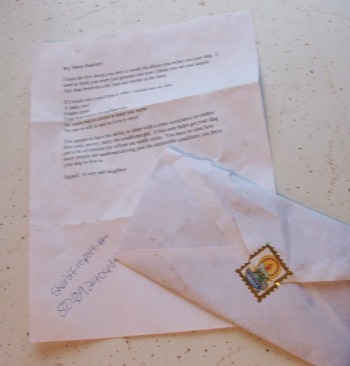 We got another anonymous note complaining about our livestock guardian dog’s living conditions again. It’s been a while since the last one. I logged another Sheriff report on it, and will keep the evidence, as usual, as the Sheriff has advised. That way, if anything ever escalates, we’ll have a clear history of harassment with handwriting samples and fingerprints, on which to prosecute.
The envelope said, in scrawling cursive, “To our neighbor” and was sealed with a cheerful Christmas sticker. 😉 Here is what the note said [sic]:
Continue reading “A Spell Caster’s Christmas-ey Complaint Letter”
Washing Down Comforters

When Kirk and I got married, he brought with him two favorite down comforters. I’d always chosen cotton and polyester blend bedding; because I let the dogs on the bed, I need to wash the bedding a lot! So I cringed as I saw this lovely pale pink comforter get dirtier and dirtier as Maggie slept on it every night. I know, we could just not let the dogs in the bed, and it’s really only Maggie who gets up there. But she’s such a cute snuggler, I just can’t resist! And Kirk doesn’t tell her no either! She usually sleeps by my pillow every night.
So, I went to the Web for advice on cleaning feather down comforters. It turns out, you can safely wash them in a front-loader washing machine; and I’ve done it several times now. The great thing about front-loaders is that they spin the load at such high speeds, they drive most of the water out of the load with centrifugal force before it goes into the dryer. So, clothes- and down comforters- are almost dry when they come out of the wash! One of the many reasons I love my front-loader so!
I’ve read several recommendations to dry the comforter with some tennis balls, or tennis shoes, in the dryer- to help fluff the feathers via some pounding action. I did this the first time (we have lots of tennis balls for the dogs), and it worked, but have since found that it’s not necessary, at least in my dryer. The only caveat is that the comforter does have a weird smell when wet-exactly like a wet chicken, because it is! But, the smell goes away once dry. It takes a little longer than a regular clothes load to dry the comforter, and I remove it and rearrange it several times during the cycle to make sure all sides get equally dry. But, it’s the same as washing any other large comforter.
I guess this makes sense, after all, chickens dry fine after getting wet, so a feather down comforter should too, given the right conditions. So, hooray, we can keep the down comforters!
Treo Hit By Truck, Literally
 I was crossing the street the other day to get the mail. A large delivery truck appeared, driving very fast (like everyone does on this road…). I sped up to be sure I was off the road by the time the truck got close, and my cell phone fell off, it was clipped to the pocket of my pants. I looked back, there it was, in the middle of the lane, I looked at the truck: no time to dive for cell phone.
I tried to make eye contact with the truck driver and then look at the phone in its brown leather case, drawing his attention to it. If he would have stayed centered in the lane, the phone would have been safe. But, no, he veered, as if he thought he needed to give me more room as I stood on the shoulder. The tires went squarely over the phone. <sigh>
New Laws For LGDs in SnoCo
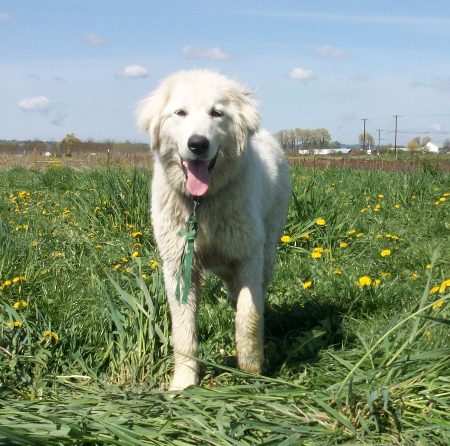 Ok, I’m writing about something other than copper! 🙂 I read about some proposed changes to the Snohomish County leash and noise ordinances that relate to livestock guardian dogs (LGDs). As the law currently stands, dogs can’t run loose in our county, and they can’t make continuous noise (aka kennel barking, where they go on and on for more than a half hour).
But, there is an exemption for LGDs in the barking category, since they are doing their job protecting an agricultural crop. When people purchase land zoned R-5 or Ag-10 in our county, they must sign an affidavit that they understand there will be “agricultural activity, smells and sounds”. (Mmm!) And LGD barking falls under this umbrella. So if people call the county to complain about this, they’ll just be told, “sorry, it’s within the law for your area.”
Calculating Copper in a Sheep’s Diet
 Well, I can’t stop thinking about copper, and how much to allow my sheep to eat. And I’m going to keep blogging about it until I figure it out! 🙂 Sorry if it’s getting boring, eventually I’ll get past this phase!
So, as Kirk can tell you, when I’m in a period of indecision, I make a spreadsheet! I love spreadsheets. Looking at math and side-by-side comparisons of things always helps me think through a problem.
I’m Pretty Jazzed About My Sheep’s Hooves!
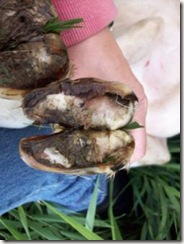
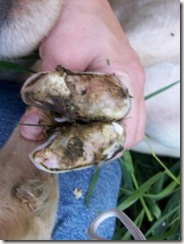
I did some hoof trimming on the sheep yesterday, to see how things are looking after the sheep have been getting supplemental copper. Oh my gosh, oh my gosh, oh my gosh. They are looking SO good, the improvement and healing is profound! I should qualify, though, that there is more than one variable at play, so I can’t yet credit the copper supplement. Though I feel fairly sure that’s what it is.
Continue reading “I’m Pretty Jazzed About My Sheep’s Hooves!”
Ready for Winter Feeding
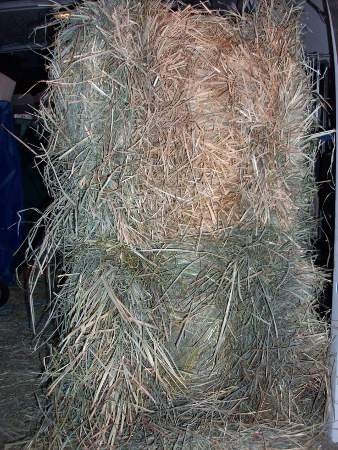 It’s hard to decide how much hay to store for winter. It’s cheapest to buy in the summer, so if you don’t store enough and have to buy more at the end of the winter, it costs more. But, if you put up way too much, then you’ve spent money you didn’t need to. And old hay isn’t worth much the following year, so is often just used as bedding material.
Ready for Winter Flooding
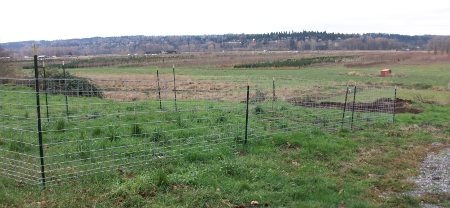 I was pleased with myself for being prepared for winter flood season well before it came on. We had taken down our little “flood pen” during the summer so we could mow that area. I re-built it slightly bigger for this year, to accommodate more sheep. It’s far from roomy, and nobody has a good time if it floods and the sheep have to stay crammed in there for a few weeks. But, it’s only a few weeks, so we’d get through it. And now that I have portable hotwire, I’d have some options of moving the sheep around while waiting out a flood.